
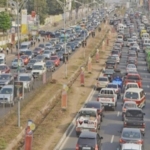
The solution to the soul-crushing traffic congestion paralyzing Ghana’s capital may not require years of construction, but rather 90 days of decisive administrative action.
In a bold assertion on Joy FM on Thursday, January 15, 2026, Mr. Benedict Arkhurst, the Head of Plan Preparation at the Land Use and Spatial Planning Authority (LUSPA), claimed that Accra’s transport nightmare could be significantly mitigated within just three months if the government pivots from planning to aggressive enforcement.
While many believe the answer to Accra’s congestion lies in multi-million-dollar interchanges, Mr. Arkhurst argues that the networks and blueprints are already in the state’s possession.
He revealed that the government invested approximately €2 million (roughly GHS 35 million) in a National Special Development Framework that remains largely unexploited.
“The plans are already there. If we roll them out within two or three months, we should be good to go because the networks are already there, and it is a matter of enforcement to ensure that,” Mr. Arkhurst stated.
The official’s frustration stems from the fact that the state has already paid for international expertise to diagnose and solve the city’s mobility issues. “The government sponsored these plans for them to be prepared… which cost the government almost two million euros,” he disclosed.
At the heart of LUSPA’s strategy is a transition to a high-capacity Arterial Bus System.
Rather than a total city-wide overhaul—which often stalls due to funding—Mr Arkhurst proposed a phased pilot approach targeting the most congested corridors, such as the Madina-Adenta, Kasoa-Mallam, and Tema Motorway routes.
“The arterial bus system we proposed is about five. Let us start with the pilot; let us look at where traffic is very heavy, let us develop two of the networks and pilot and see whether it will really help to improve the situation, then we can do it in phases,” he suggested.
The strategy involves dedicating existing road space exclusively to high-occupancy vehicles during peak hours, effectively bypassing the bottleneck of private cars and commercial vehicles.
“We can even try with one. Once we see positive signs and all that, we can now go ahead and do the rest,” he added.
The three-month timeline hinges on one critical factor: Enforcement.
Mr. Arkhurst noted that the physical roads (the networks) exist, but they are currently managed inefficiently.
He argued that if the Ministry of Transport and the Department of Urban Roads enforced lane discipline and cleared unauthorised trading hubs that spill onto the tarmac, the city would breathe again almost instantly.
| Phase | Duration | Primary Action | Expected Outcome |
| I: Preparation | 30 Days | Identify 2 key corridors & engage stakeholders. | Ready for rollout. |
| II: Pilot Launch | 30 Days | Dedicate lanes for high-capacity buses; strict policing. | Immediate reduction in commute times. |
| III: Assessment | 30 Days | Review data & plan for the remaining 3 arterials. | Scalable model for GAMA. |
The urgency of Mr Arkhurst’s proposal is backed by staggering economic data.
Estimates from the Ghana Institute of Engineers suggest that the country loses nearly $2 billion annually in lost productivity, fuel wastage, and health complications due to Accra’s traffic.
By highlighting the €2 million price tag of the existing blueprints, LUSPA is signaling that the greatest waste is not the lack of infrastructure, but the refusal to use the tools already bought and paid for.
About the Author
