
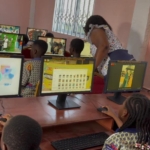
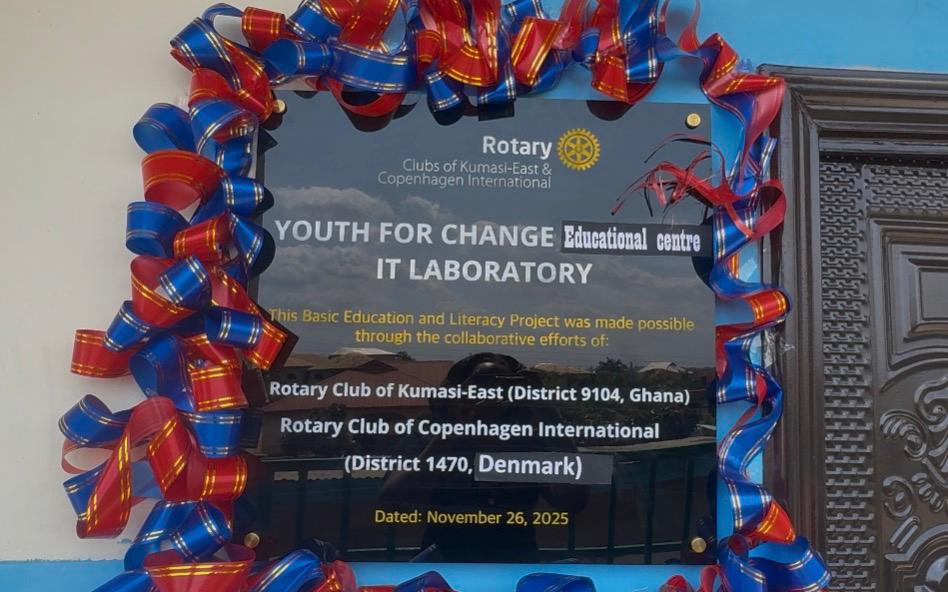
The Rotary Clubs of Kumasi-East and Copenhagen International have commissioned a fully-equipped ICT laboratory for the Youth for Change Educational Centre, a project aimed at strengthening digital literacy and employable skills among children in one of Kumasi’s underserved communities.
The facility is the latest in a series of interventions valued at $41,000, and includes 25 desktop computers, a projector, a scanner, and a CCTV security system installed across the campus.
The new ICT lab adds to previous Rotary-funded projects for the school, including a library and a modern kitchen laboratory that has already been integrated into the academic curriculum.
President of the Rotary Club of Kumasi-East, Gina Akosua Acheampong, explained that the project was designed to give students practical skills that create pathways to employment.
“Unemployment is very high now. These students already know how to bake pastries through our earlier projects, and now we are giving them digital skills. We want them to acquire abilities they can use immediately after school, even from home,” she noted.
Gina Acheampong added that the club is expanding access to the facility beyond the school, with plans to allow selected inmates from the Amanfrom Prisons to use the computer lab under supervision.
“In our generation, technology is everything. We want inmates who come here to leave with knowledge of what is going on in the world. The computers are restricted strictly to learning, and officers will guide who is allowed to come here and access,” she said.
Past Assistant Governor and Ethics & Governance Chair for Kumasi-East Rotary, Awal Babah-Alargi, said the project aligns with Rotary’s core focus on education, especially in communities where families cannot afford high-cost private schools.
“We have areas of focus, and education forms part of it. Looking at the community around here, not many of them can afford to attend expensive schools. So as Rotarians, we don’t do things for one person, we choose projects that benefit many,” he expressed.
Despite the challenges posed by sharp currency fluctuations, the club was still able to deliver the project in full. When the budget was initially submitted, the exchange rate stood at GH₵16 to $1, but by the time the funds arrived, the cedi had appreciated to GH₵10, creating a significant gap in projected costs.
Rotary leaders say this experience highlights the importance of sustainability and careful planning in all their projects.
Project Chair Engineer, Francis Tettey-Ahwah, explained that long-term maintenance is crucial, especially because Rotary projects are funded through small contributions from many individuals.
“Sustainability is key in Rotary. People dip into their pockets little by little to make these projects possible, so we take it very seriously. We will return in a year or two to check the facility and report back to Copenhagen. When they see everything is in order, more support will come,” he cautioned.
Principal of the Youth for Change Educational Centre, Ali Ibrahim, expressed gratitude for the continued investment in the school’s mission.
“Thank you so much to Rotary Club Copenhagen for the funding and Rotary Club Kumasi -East. We are very grateful for this gesture. We were recommended to them because of the impact we are making. We want to make a difference and break the gap on digital literacy,” he said.
About the Author
