
The National Road Safety Authority, in collaboration with the Motor Traffic and Transport Department of the Ghana Police Service, has commenced a nationwide sensitisation exercise aimed at promoting safer road use ahead of the Easter festivities.
The initiative forms part of an ongoing Visibility Programme designed to intensify road safety education and enforcement across the country, particularly along identified high-risk corridors.
The exercise, which started on Monday, March 30, will end on Tuesday, April 7, 2026.
It is being carried out on major highways, including Accra–Cape Coast, Accra–Suhum–Kumasi, Accra–Aflao, Akosombo–Ho, Aburi–Akropong, and Accra–Suhum–Bonso.
It focuses on educating all categories of road users; commercial drivers, private motorists, motorcyclists, and pedestrians, on best road safety practices such as adherence to speed limits and traffic regulations, the use of seatbelts and helmets, and the avoidance of distracted and impaired driving.
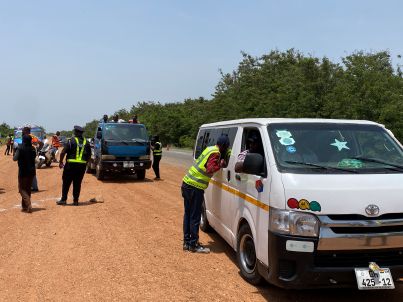
Addressing the media on Tuesday during the exercise along the Shai Hills road in the Dangme West District, Director of Research, Monitoring and Evaluation at the NRSA, Alexander A. Ayatah, said the initiative was crucial in tackling the rising incidence of road traffic crashes and casualties in the country.
He urged all road users to exercise caution, particularly during the Easter period when vehicular movement is expected to increase.
“I expect that as we send out this information, drivers, passengers, riders and pedestrians will take heed so that we can have an accident-free Easter. This is not the time for speeding, drunk-driving, or reckless behaviour on our roads,” he said.
Mr Ayatah highlighted the need for collective responsibility, calling on passengers to act as “co-drivers” by cautioning drivers who engaged in dangerous practices.
He noted the importance of sustained public education and enforcement, adding that the campaign would continue beyond the Easter period.
“We cannot afford to lose lives. Ghana needs everyone. One life lost is too many, and we must all work together to reduce these numbers,” he added.
Mr Ayatah called for increased investment in road safety, indicating that inadequate funding had previously affected the scale of such campaigns.
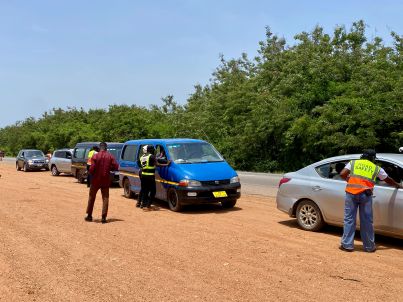
Road crashes, he noted, continued to have economic implications, with losses estimated at about 1.6 per cent of Ghana’s Gross Domestic Product.
He called on all stakeholders, including the media, community leaders, and the public, to support ongoing efforts to promote road safety and reduce fatalities on Ghana’s roads, especially during the festive season.
Deputy Superintendent of Police (DSP) Oppong Kyekyeku, Staff Officer at the Motor Traffic and Transport Department, said the exercise was primarily focused on education rather than prosecution.
He noted that some drivers exceeded speed limits significantly, especially in restricted zones.
“A driver is not supposed to exceed 30 kilometres per hour on the Shai Hills road, yet some were driving at 120 or 150 kilometres per hour. This is dangerous and must stop,” he said.
DSP Kyekyeku added that officers also removed unapproved lights from some vehicles, explaining that such lights could impair the vision of oncoming drivers and increase the risk of accidents.
He urged motorists to comply with road traffic regulations and prioritise safety even beyond the Easter period.
About the Author