
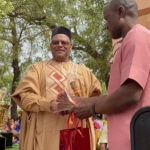
A former student of Bawku Secondary School, Professor George Agbango, has donated GHS50,000 to his alma mater to support its development, describing the gesture as a fulfilment of a promise he made during the school’s 60th anniversary celebrations, where he served as chairman.
The donation was made during a visit to the school on Tuesday, where Prof Agbango addressed students, staff, old students, and community members, sharing a deeply personal account of his journey and the role Bawku Secondary School played in shaping his life.
According to the Headmaster, Rev. Abugbila Bukari, the cash support forms part of Prof Agbango’s long-standing commitment to the school. He noted that in 2024, Prof Agbango donated eight computers to strengthen the school’s ICT capacity and has, over the years, presented several trophies to support sporting activities.
Addressing the gathering, Prof Agbango expressed gratitude to members of the Old Students Association and other supporters who joined him for the presentation.
He reflected on his days as one of the pioneering students of the school when it was established in 1963.
“We came here in October 1963 as young students, just like you,” he told the students.
“There were only 75 of us occupying the first two classes of this building. When we got here, the whole land was barren.”
He recalled how the founding headmaster, Agyeman Dickson, instilled discipline and long-term thinking in the students, particularly through tree planting.
“We had a headmaster who had a vision. We planted all these trees you see today,” he said.
“Anytime the headmaster was coming down in the morning, he would test the soil to see whether it was watered.”
In a light-hearted moment, Prof Agbango narrated how he was punished by being put in charge of watering the trees.
“The head prefect didn’t like me so much, so he made me in charge of watering the trees,” he said, drawing laughter.
“So if there are mangoes still standing there, I want to say those mangoes are mine, and I should be the first to eat them.”
Using the story to teach a lesson, he urged students to think beyond themselves.
“I say this to let you know that whatever you are doing here, you are not doing it for yourself. You are doing it for generations yet to come,” he advised.
The Bloomsburg University lecturer also described the school as the foundation of his success, stressing that early education matters more than people often realise.
“No building can stand unless the foundation is good,” he stated. “That is why we take Bawku Secondary School very seriously as old students. I would not have been where I am today but for Bawku Secondary.”
He shared his difficult academic beginnings, explaining that he did not pass all his subjects after Form Five and had to resit his exams while teaching.
“We didn’t have many teachers. We didn’t have books. We didn’t even have electricity; we used a generator,” he recalled.
“But the teachers worked hard with us.”
Prof Agbango traced his journey from teaching at middle and secondary schools, through teacher training college, to politics, where he became a Member of Parliament in 1979 at the age of 28.
“Bawku Secondary School was shining in Parliament,” he said, as he recounted leading Ghana’s delegation to the United Nations and later to the Soviet Union.
He also narrated how a military coup forced him to flee Ghana, eventually leading him to the United States, where he returned to school and rebuilt his life.
“One day, my friend told me, ‘George, redefine yourself. Go back to school,’” he said. “That advice changed my life.”
Prof Agbango told students how he worked menial jobs in the US to survive while pursuing his master’s and doctoral degrees.
“I worked as a loading boy. When trucks came with boxes, I offloaded them,” he said.
“That was how I survived, finished my master’s, and went on to do my doctorate.”
He later became an assistant professor and rose to become chair of department at a university in the United States, describing his journey as proof that perseverance pays.
“Progress will come your way,” he assured the students.
Explaining the motivation behind his donation, Prof Agbango said giving back was a moral responsibility.
“There’s a saying that charity begins at home,” he said.
“This school gave us the momentum and foundation to succeed in life.”
He added:
“If the opportunity granted me as a professor in the United States allows me to earn a good income, I should not rest and be happy with my family alone. I should be able to give back to the school that made it possible for me to get a good education.”
Detailing his contributions, he said:
“That is why every now and then I send trophies to support sports in this school. I send computers to support the computer lab, and now I’m giving a cash donation of 50,000 Ghana cedis.”
Describing the amount as modest, he urged other old students to contribute.
“It’s just a drop of water in the bucket, but little drops of rain make a mighty ocean,” he said.
“If all former students do the same, we will go a long way in helping the school.”
Prof Agbango highlighted the growth of the school from 75 students in 1963 to over 3,000 students today, noting that expansion comes with challenges.
“The more buildings you have, the more students you admit, the more challenges you face,” he said.
“That is why depending only on government is not enough.”
He called on philanthropists, parents, and old students to support the school, expressing optimism about its future.
“If we all do our best, this school will become as famous as the schools in the South,” he said.
He also praised the school’s progress in promoting girl-child education, describing it as a positive sign for the northern sector.
“When you have more female students, it shows we are rising to meet a long-neglected need,” he said.
“I applaud the headmaster for taking steps to ensure that many girls are enrolled in this school.”
The donation was warmly received by school authorities and students, who expressed gratitude to Prof Agbango for his continued support and commitment to the growth of Bawku Secondary School.
About the Author
