
Leaders of the One Volta Group (OVG), an advocacy and development-oriented organisation registered in Ghana and the United States, have unveiled an ambitious proposal to construct an Integrated Transshipment Deep Seaport at Keta as a transformative response to coastal erosion and economic decline along Ghana’s eastern coastline.
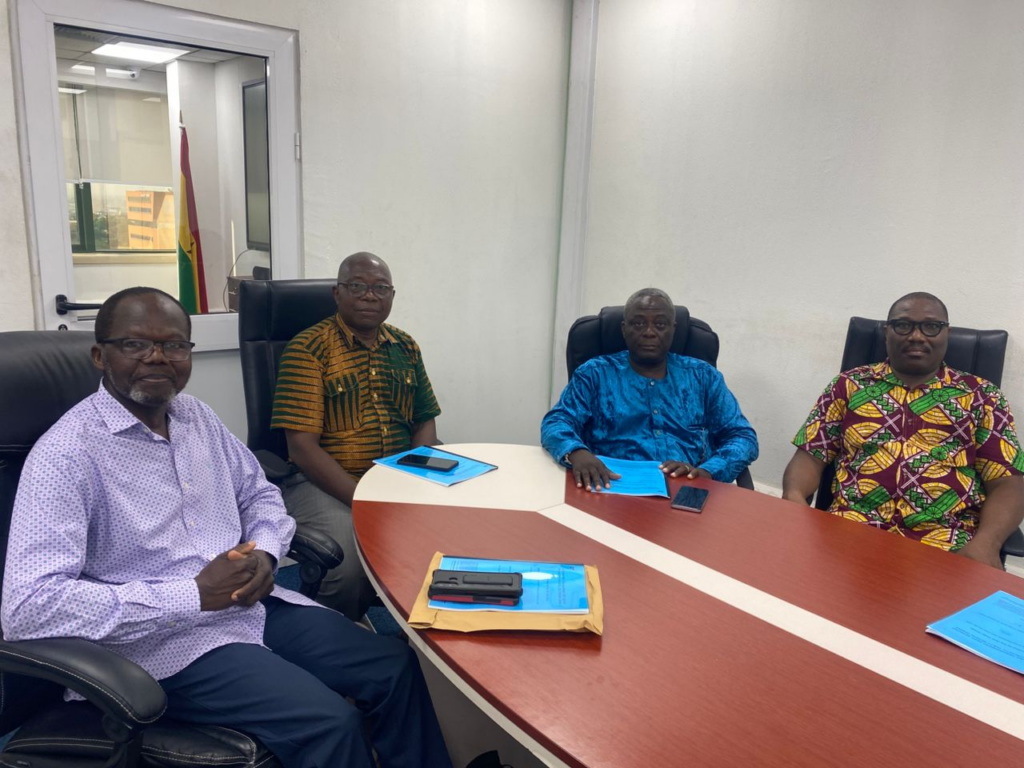
The proposal was presented during a visit to a member of the Presidential Advisory Group on the Economy (PAGE) and the Agbogbomefia of the Asogli State, Togbe Afede XIV, on Tuesday, March 3, in Accra.
The OVG delegation was led by its Chairman, Kossi Amuzu Nutekpor, and included:
- Togbe H. Amedzake III – Executive Director, OVG Ghana
- Mr Seth Owusu – Engineer, OVG Technical Team
- Mr Frank Bobuafor – Member, OVG Technical Team
The team outlined a comprehensive development vision aimed at reversing decades of environmental degradation and repositioning Keta as a major maritime and economic hub in West Africa.
The proposal comes in response to escalating coastal erosion along the stretch between Aflao and Atiteti, which has devastated communities, displaced residents, and weakened the regional economy.
Keta, historically a vibrant centre of commerce and culture, has suffered significant land loss and socio-economic decline. Much of the town lies below sea level, making it highly vulnerable to rising sea levels and storm surges linked to climate change.
Fishing communities such as Fuveme and Kporkporgbor have already disappeared entirely, their existence preserved only in oral tradition.
Although successive governments have undertaken sea defence initiatives — including the Keta Sea Defence Projects — these interventions have largely provided localised protection without delivering long-term economic transformation.
OVG presented three options to address the challenges confronting Keta and its surrounding coastline. Importantly, the first two options reflect current government proposals already being pursued, while the third represents the flagship solution being championed by the One Volta Group.
This option involves continuing and modestly enhancing historical coastal defence projects and community-led initiatives.
While relatively lower in cost and quicker to implement, OVG noted that this approach does not address the structural causes of erosion nor stimulate significant economic regeneration. It remains primarily a protective intervention.
The second option is the government-designated Keta Port project at Kedzi, established under Executive Instrument 251 (2018). This initiative seeks to expand maritime infrastructure and provide some relief from erosion.
However, its scope is considered more limited, focusing on incremental infrastructure expansion rather than comprehensive economic transformation.
The third option — and the one OVG hopes will carry the day — is the development of a fully integrated Transshipment Deep Seaport within the Keta Municipality.
At the core of the proposal is a 5,000-metre marginal wharf capable of accommodating Ultra-Large Container Vessels (ULCVs) of up to 24,000 TEUs, with an annual throughput capacity of five million TEUs.
The port would operate under a global “hub-and-spoke” Transshipment model, where large mother vessels discharge cargo at Keta for onward redistribution to regional ports via feeder vessels. This would significantly reduce per-container shipping costs and enhance Ghana’s competitiveness in maritime trade.
Crucially, the embankment structure forming the foundation of the port would double as a permanent and robust coastal defence system, offering long-term protection against erosion.
OVG envisions Keta evolving into a West African maritime gateway similar to the Port of Chancay in Peru — a Chinese-backed deep-water transshipment hub designed to transform regional trade and global connectivity.
The proposal also includes complementary railway infrastructure linking the port to Ghana’s mineral-rich Volta Region — including lithium and iron ore deposits — and extending into landlocked Sahelian states such as Burkina Faso, Mali, and Niger.
Such integration, OVG argues, would foster industrialisation, boost exports, create jobs, and strengthen Ghana’s position as a regional logistics hub.
Togbe Afede XIV welcomed the proposal and highlighted its potential to reverse youth migration and stimulate local enterprise.
“Instead of the youth migrating away from Keta, they will remain in their own areas because the jobs will come. They will get work to do. Businesses will also move into Keta,” he said, acknowledging ongoing government sea defence initiatives.
However, he emphasised that feasibility would be decisive.
“What is important is its feasibility… Of course, I know that the economic benefits can also feed the viability,” he remarked, noting that while governments may prioritise job creation, private investors and development institutions will focus heavily on commercial returns and cargo volumes.
Drawing on his experience in shipping and infrastructure projects, he stressed that the viability of such large-scale investments ultimately depends on volumes.
“It is a challenge to build a kilometre of railway here, which costs the same as building it in America, almost. The difference is that America has bigger cargo and numbers to sustain it,” he explained.
“The need has always been felt. The need is there. But it’s a numbers game,” he added.
Despite the challenges, he described the project as conceptually sound and exciting.
“These are very, very beautiful projects… Conceptually exciting and sound. Feasibility is just another dimension altogether,” he concluded.
About the Author
