In a decisive move to break the devastating cycle of market fires that have plagued Ghana’s commercial hubs, the National Disaster Management Organisation (NADMO) has launched a comprehensive nationwide assessment of all market layouts.
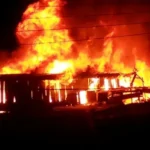
The initiative, announced this week, marks a major policy shift toward proactive disaster prevention following a massive inferno at the Kasoa New Market on Sunday, January 4, 2026.
That fire—the second to hit the same section of the market in under a year—razed over 360 stalls and destroyed goods worth millions of Ghana Cedis.
Working in close coordination with the Ghana National Fire Service (GNFS), NADMO’s specialised teams are now auditing major trading centres to identify death traps caused by poor structural planning.
The exercise targets three critical failure points: blocked access routes for fire engines, illegal electrical connections, and the absence of fire hydrants.
During a visit to present relief items—including mattresses, blankets, and essential food supplies—to the distraught traders at Kasoa, the Director of NADMO’s Inspectorate Unit, Richard Amo Yartey, emphasised that the time for standby repairs is over.
“There’s a serious collaboration ongoing, being coordinated by NADMO, and sensitisation in all the markets across the country has been heightened. This is one of the ways to ensure the prevention,” Mr. Yartey told reporters.
“So, we are actively working with all authorities to ensure that fire prevention is heightened in this country. The reconstruction will seek to look at all these things and then cover all the gaps that were identified.”
The Awutu Senya East Municipality is set to become the test case for this new structural philosophy. Local authorities have vowed that the reconstruction of the Kasoa New Market will not be a mere replacement of wooden stalls but a complete architectural redesign.
Phyllis Naa Koryoo Okunor, the Member of Parliament for Awutu Senya East, confirmed that technical experts have already hit the ground to map out a fireproof commercial hub.
“Since yesterday, we’ve had consultants on the ground here to survey the place, to measure up the place, and to do some paperwork. This paperwork would include a reconstruction of the market, this area that got burnt, which would include a fire station and fire hydrants,” Ms. Okunor stated. “The fire hydrants would not just be here; they would be within certain specific places of the market.”
The 2026 safety drive comes as Ghana grapples with an alarming surge in fire-related incidents.
According to GNFS data, fire injuries and deaths saw a 33% rise in the first half of 2025 alone, with major markets in Kantamanto, Adum, and Techiman falling victim to the flames.
Stakeholders like Dr. Kingsley Agyemang, MP for Abuakwa South, have recently argued that allowing traders to lead their own reconstruction is a fundamental flaw because traders lack the engineering knowledge to build fire-resistant structures.
The new NADMO-led approach aims to centralise this oversight under Municipal and District Assemblies (MMDAs).
About the Author