The government has announced plans to establish special drug courts to speed up the prosecution of people arrested for drug use and trafficking, following a sharp rise in drug-related arrests across the country.
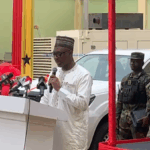
The announcement was made by the Minister for the Interior, Muntaka Mohammed-Mubarak, during a donation ceremony where pickup trucks and motorbikes were presented to the Narcotics Control Commission (NCC) to support its operations nationwide.
Speaking at the event, the minister said the creation of specialised courts has become necessary to ensure that arrests lead to timely justice.
“Government recognises that effective drug control does not end with arrests and seizures. A sustainable impact requires credible prosecution and timely justice.”
According to data from the Ministry of the Interior, arrests made by the NCC rose significantly between 2024 and 2025. The number of cases increased from 56 to 158, representing a 182 per cent rise.
The minister noted that enforcement outcomes continued to improve throughout 2025, attributing the progress to sustained government support and the leadership of the Director-General of the Commission, Jaira Matwao-Obe-Mantei, and his management team.
“Recent enforcement outcomes show that government support for the Narcotics Control Commission is producing results,” he said.
During the same period, officers seized 840 kilograms of cannabis and 341 kilograms of cocaine. The Interior Minister said the seizures confirm Ghana’s active role in detecting and disrupting international drug trafficking networks.
He also pointed to changes in the drug market, explaining that trafficking methods are evolving. He said data shows that travel-related trafficking accounts for 23 per cent of new psychoactive substance interceptions, while the remaining 77 per cent involves other emerging substances.
Against this background, the Narcotics Control Commission intensified targeted enforcement patrols during the festive and fasting season from December 2025 to January 2026. These operations focused on identified hotspots in Accra and other strategic locations across the country.
Mr Mohammed-Mubarak said the special operations disrupted drug distribution networks at a critical period, strengthened deterrence and contributed directly to the improved enforcement results recorded.
To address delays in the justice process, the minister said the government is deepening collaboration with the Attorney-General’s Department and holding advanced discussions on setting up specialised narcotics courts.
“This is why we continue to support efforts to strengthen the Narcotics Control Commission’s core mandate. We are working towards the establishment of specialised narcotics courts to fast-track drug-related cases and enhance deterrence,” he said.
Touching on the vehicles donated to the Commission, the minister said that they were not symbolic gestures but critical operational tools.
“These vehicles are not symbolic. They are strategic resources aimed at enhancing rapid response and nationwide operations. They are public assets.”
He therefore urged management and officers of the Commission to ensure the vehicles are used responsibly.
“I expect their proper management and strict deployment for official duties only, guided at all times by professionalism and accountability,” he added.
About the Author