
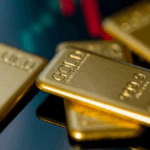
Gold and silver prices hit record highs, but share prices fell on Monday as investors reacted to US President Donald Trump’s threat to impose fresh tariffs on eight European countries opposed to his proposed takeover of Greenland.
The price of gold touched $4,689.39 (£3,499) an ounce on Monday, while silver rose to a peak of $94.08 an ounce.
Precious metals are seen as safer assets to hold in times of uncertainty, and the prices of both gold and silver have soared over the past year.
But stock markets in Europe fell as investors worried over the latest increase in geopolitical tensions.
On Saturday, Trump announced a 10% tariff on goods from Denmark, Norway, Sweden, France, Germany, the UK, the Netherlands and Finland would come into force on 1 February, but could later rise to 25% – and would last until a deal on Greenland was reached.
Reports have suggested the EU is considering responding with a €93bn (£80bn) package of tariffs on US imports.
Worries over the Greenland spat triggered another rise in gold and silver prices as investors headed for “safe haven” assets.
Last year, the price of gold soared by more than 60%, partly due to concerns about global tensions and economic uncertainty.
However, there are other factors behind the rise, including expectations of more interest rate cuts, central banks adding hundreds of tonnes of gold to their reserves and – in regard to silver – China announcing restrictions on exports of the metal.
“Gold has hit fresh record highs on its glittering run upwards,” said Susannah Streeter, chief investment strategist at Wealth Club.
“The precious metal is holding even more allure as a safe haven as worries spread about the repercussions of the US aggressive trade and geopolitical policies.”
But while gold and silver were continuing their recent strong runs, shares were on the back foot.
London’s FTSE 100 index fell 0.4%, while the FTSE 250 – which has a greater number of domestically focused companies – was down 0.8%. A mixture of financial firms and industrial stocks were lower, but shares in gold miners Fresnillo and Endeavour rose following the latest increase in precious metal prices.
Across Europe shares in carmakers, tech and luxury goods firms saw sharp falls.
In Germany, the Dax index fell 1% with car companies BMW, Mercedes-Benz and VW all down by about 3-4%.
In France, the Cac 40 index was down 1.4%, with luxury brands LVMH and Hermes among the biggest losers.
However, European defence stocks rose, with Germany’s Rheinmetall and France’s Thales both trading higher.
Markets in the US are closed on Monday for a public holiday.
Dan Coatsworth, head of markets at AJ Bell, said Trump’s latest tariff threat “turns up the heat to max”.
However, he noted that “while we’ve seen a red day for European shares in general, it’s not panic time”.
“What needs to be watched closely is how markets behave over the near term. A 1% to 1.5% decline every day over a series of weeks adds up to trouble, and that’s what investors are keen to avoid happening.”
Trade tensions are one of the main risks to global economic growth, according to the latest forecast from the International Monetary Fund (IMF).
In its latest world economic outlook – prepared before the latest tariff threat emerged – it described the global economy as “steady”, but said risks to growth included an end to the AI boom and a “flare up” in trade tensions.
About the Author