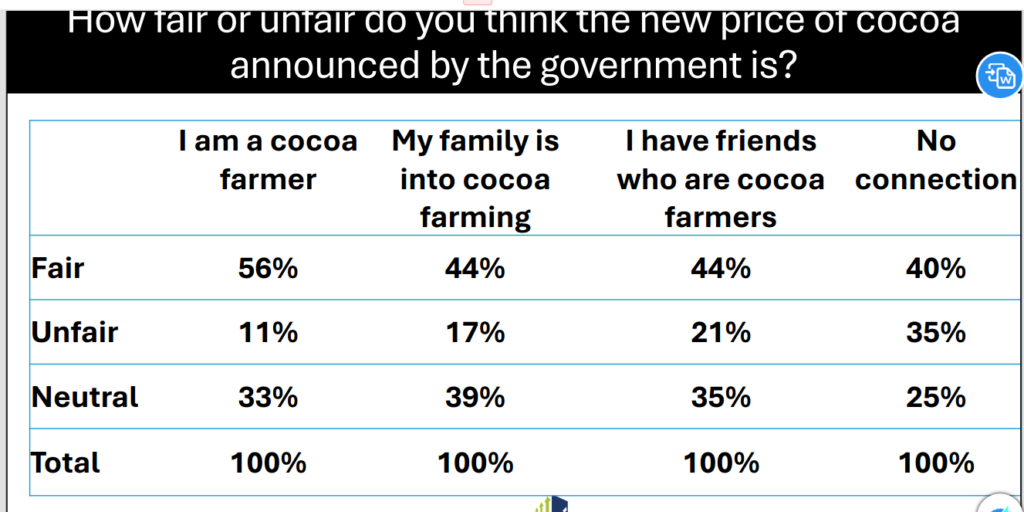
A recent survey by Global InfoAnalytics has revealed that most cocoa farmers in Ghana believe the government’s newly announced farmgate price is fair, despite street protests and criticism from opposition politicians.
According to the poll, 56% of cocoa farmers said the new price was fair, while only 11% called it unfair, with 33% remaining neutral.
The findings come after widespread unrest following the Producer Price Review Committee’s (PPRC) announcement on February 12, 2026, that pegged the new farmgate price at GH¢41,392 per tonne — equivalent to GH¢2,587 per 64-kilogram bag, down from GH¢3,625 in October 2025, a reduction of roughly 28.6%.
Finance Minister Dr Cassiel Ato Forson, who chairs the PPRC, defended the adjustment, citing a collapse in world cocoa prices.
“Global prices have fallen to about $4,100 per tonne from an average of $7,200, making Ghana’s beans uncompetitive and discouraging international buyers,” he said.
He added that the new price represents 90% of the achieved Free on Board (FOB) export price, higher than the roughly 70% ratio under the previous pricing.
Despite the protests, COCOBOD has been making payments to farmers. An initial GH¢237 million covering 50,000 metric tonnes was released, followed by GH¢854 million as of February 19. However, many farmers insist the funds have yet to reach the farmgate.
The government has also announced broader structural reforms alongside the price cut. A new Cocoa Bill will be presented to Parliament to prevent COCOBOD from undertaking quasi-fiscal expenditures, introduce automatic price adjustments guaranteeing farmers a minimum of 70% of the gross FOB price, and replace the international syndicated loan model with domestic cocoa bonds.
Officials are also committed to covering an estimated $150 million in losses from purchasing approximately 50,000 metric tonnes of beans already supplied at the old, higher price.
COCOBOD CEO Randy Abbey described the board’s current financial position as “the most precarious in its nearly 80-year history,” inheriting a “negative equity” of GH¢3.8 billion, a first in the institution’s history.
The Global InfoAnalytics poll, conducted between February 19 and 24, sampled 7,554 people across 83 constituencies in all 16 regions, with a confidence level of 99% and a margin of error of ±1.5%.
Across all respondents, 44% said the new price was fair, 31% unfair, and 26% neutral.
Party affiliation strongly influenced opinions. Among NPP supporters, 53% said the price was unfair, compared to 14% of NDC supporters. Floating voters were more balanced, with 42% rating the price as fair and 29% as unfair.
Regionally, Western North showed the highest dissatisfaction, with 62% deeming the price unfair, while Savannah (85%), Central (60%), and Western (60%) were among the most supportive.
A coalition of cocoa farmers has signalled willingness to accept lower prices for future deliveries if the government first clears all outstanding arrears.
The poll suggests many farmers share a similar pragmatic view: frustrated by the cut, but realistic about market realities.
About the Author