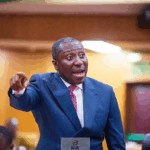
Minority Leader, Alexander Afenyo-Markin, has raised concerns over the government’s decision to deploy troops and ship relief items to Jamaica for post-hurricane reconstruction, arguing that Ghana’s own unresolved domestic challenges make such international commitments deserving of closer parliamentary scrutiny.
Speaking on the floor of Parliament on Wednesday, December 17, Mr Afenyo-Markin questioned the transparency surrounding the relief efforts and the prioritisation of resources at a time when parts of Ghana are grappling with disasters.
His remarks follow the government’s deployment of troops from the 48th Engineering Regiment of the Ghana Armed Forces to Jamaica, for reconstruction after a hurricane destroyed public and private infrastructure in the country.
He noted that Parliament had not been adequately briefed on the procurement and sourcing of the relief items reportedly being sent to Jamaica, nor the agencies involved in the process.
“All we hear is that some amount of relief is being provided. We do not know how these items were procured, the processes involved, or which agency is donating these items to central government,” he said.
The Minority Leader pointed to recent flooding incidents in Ghana, stressing that affected communities have struggled to access relief items, raising questions about the government’s capacity and prioritisation.
“In this country, we have serious disasters. After the recent flooding, people have been calling for relief, and we are told there is no stock. When you do not have enough to feed your own at home, doing international charity will require a curious concern,” he stated.
While acknowledging Ghana’s obligations in maintaining cordial foreign relations, Mr Afenyo-Markin insisted that Parliament must be fully informed about the scale, cost, and justification for such international interventions.
“It is important that we are briefed on the extent to which this is being done,” he added, directing his concerns to the Majority Leader.
He further criticised what he described as the exclusion of Parliament and its relevant committees from the decision-making process, particularly regarding the shipment of relief items.
“Yesterday, we read in the news that some relief items were being shipped out, and that the military high command had gone to inspect them before shipment. I have checked with my colleague, the Ranking Member on Defence and Interior, and the committee has not been involved,” he said.
Mr Afenyo-Markin argued that decisions of such magnitude should not be implemented without parliamentary endorsement, stressing that lawmakers should not be learning of major policy actions through media reports.
“A major policy decision like this must receive at least the blessings of Parliament. It cannot be that Members of Parliament would be reading this in the news,” he said.
He warned that failure by ministers to adequately engage Parliament on such matters undermines accountability, questioning where else such decisions would be subjected to scrutiny if not before the House.
About the Author