
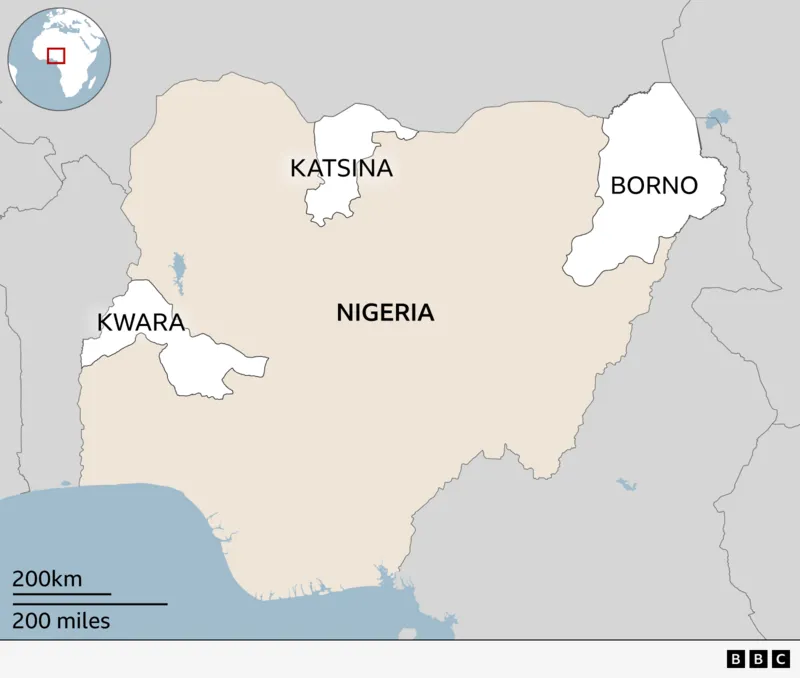
Dozens of people have been killed in a ferocious shooting attack on two villages in Nigeria’s western state of Kwara after they refused to “surrender to extremists who preached a strange doctrine”, according to the state’s governor.
Governor AbdulRahman AbdulRazaq said on X that “75 local Muslims were massacred” in Tuesday’s raid, while a state lawmaker told the BBC that 78 people had been buried so far and the death toll could rise to an estimated 170 as more corpses were being recovered.
Blaming Islamist militant group Boko Haram for the killings, President Bola Tinubu deployed an army battalion to the affected area.
The assault was one of several across Nigeria in the last few days.
In addition to the killings in the villages of Woro and Nuku, 38 people were abducted while others fled and shops and homes were set alight, said Saidu Baba Ahmed, a member of the Kwara state house of assembly.
Among the dead were two sons of the local traditional leader, who also had family members kidnapped, according to local resident Abdulla Umar Usman.
The attack began after 17:00 local time and last three to four hours, he told the BBC.
Ahmed said that Boko Haram activity had been gradually increasing in the area, saying the attack was triggered by the community’s rejection of a strict interpretation of Islam.
He explained that the Islamist group had written to the community about their arrival, saying they wanted to preach, but residents resisted and deployed local security forces.
Details about the exact number of people who died in the remote area are hard to confirm.
A Red Cross official in Kwara, Babaomo Ayodeji, told AFP that “reports said that the death toll now stands at 162, as the search for more bodies continues”.
Amnesty International said in a statement that over 170 people had died, noting many were shot at close range and some burnt alive.
The human rights group called for an investigation and said there was a “stunning absence of any form of security for the protection of lives”.
In recent months, jihadists – suspected to be from a Boko Haram splinter faction – have been active in Kwara, carrying out targeted killings, often riding in on motorcycles and attacking markets and vigilante groups set up to protect villagers.
In a press release on Wednesday, the state governor said the attack on the two villages was a result of recent counter-terrorism operations in the region.
AbdulRazaq believed it was “apparently to distract the security forces who have successfully hunted down several terrorist and kidnapping gangs”.
Tuesday also saw 21 people being killed in an attack on Doma village in Katsina state in the north, Amnesty said. On the same day 17 people were killed in a series of attacks in the north-eastern Borno state, by suspected Boko Haram militants.
The attacks come alongsidethe first official acknowledgement from Nigeria of an American troop presence since US President Donald Trump ordered the military in November to prepare for action in Nigeria to tackle Islamist militant groups.
Nigerian Defence Minister Chrisopher Musa did not provide any details about the team’s size, arrival date, location or duration of stay.
His comments follow those made on Tuesday by Gen Dagvin Anderson of US Africa Command (Africom), who said the deployment followed a Nigerian request and was focused on intelligence support.
“Our partnership with Nigeria is a great example of a very willing and capable partner who requested the unique capabilities that only the US can bring,” he said.
Nigeria faces an array of security challenges including criminal gangs – known locally as “bandits” who loot and kidnap for ransom – an Islamist insurgency, clashes over land and separatist unrest.
The US and Nigerian forces have conducted joint training programmes and exercises for decades.
But the US military has recently become more involved – launching airstrikes on Christmas Day on two camps run by the militant group known as Lakurawa in the north-west.
Late last year, the White House pressed Nigeria’s government to improve security and strengthen protections for Christian communities.
Trump had previously claimed Christians were being persecuted in Nigeria – an allegation strongly rejected by Nigeria’s government, which said Muslims, Christians and people of no faith were victims of attacks.
There are more than 250 ethnic groups in Nigeria, which is roughly divided into a mainly Muslim north, a largely Christian south, with intermingling in the middle.
Nigeria’s Foreign Minister Yusuf Tuggar said the Christmas-Day strikes were approved by Tinubu and involved Nigerian forces.
Since then security co-operation between the two nations has increased – with the US saying last month that it had delivered critical supplies to support Nigeria’s security efforts.
Nigeria’s military then told the BBC the equipment had been purchased earlier to aid counter-insurgency operations.
In recent weeks, Nigerian forces have stepped up operations against armed groups.
On Sunday, the army said it had killed a senior Boko Haram commander and 10 other militants during an operation in Borno state.
About the Author
