
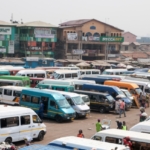
A leading research and public policy think tank, CUTS International Accra, is calling on the government to establish an Accra City Transportation Authority to regulate, plan, and coordinate transportation across the capital city. The call follows growing commuter hardship, worsening rush hour chaos, and weak coordination created by the fragmentation of the old Accra Metropolitan Assembly into multiple municipal and sub-metropolitan assemblies.
According to CUTS, Accra continues to function as one city, yet governance now operates through more than twenty assemblies working independently. Roads, drainage systems, housing development, and transport corridors cut across several jurisdictions. This mismatch has weakened planning, reduced accountability, and made effective transportation management difficult.
“You cannot run a single city with multiple transport decision centers working in isolation,” said Appiah Kusi Adomako, Esq, Director of the West Africa Regional Centre of CUTS International. “Urban movement does not respect political boundaries. Planning must follow how people live and commute.”

Between 1989 and 2017, Accra moved from one assembly to about twenty-four. CUTS notes that decentralization itself is not the problem. The challenge lies in running transportation policy in silos in a city where most residents commute daily toward one central business district.
“The creation of multiple assemblies was not a mistake,” Mr Adomako stated. “The mistake was failing to build a city-level transport authority to coordinate planning after the fragmentation.”
CUTS traced the current crisis to years of weak policy direction. In the 1970s, the Omnibus Service Authority provided predictable urban transport. Its gradual collapse left a vacuum. Metro Mass Transit, introduced in 2001, shifted focus from intra-city movement to long-haul travel. The Ayalolo system, launched in 2015, raised hope, yet suffered early setbacks after buses were diverted to other cities and private institutional use. Today, commuters struggle daily to find transport after work, while some private operators split journeys into segments and charge multiple fares.
CUTS further linked the crisis to weak enforcement of the Road Traffic Regulation 2012, Legislative Instrument 2180. Regulation 121 requires private operators to work under defined route-based systems with clear service standards. This framework remains largely inactive. Assemblies issue permits that apply broadly rather than to specific routes. Drivers therefore choose only high-profit corridors, leaving many routes underserved. In practice, transport unions allocate routes based on influence rather than planning data. “You now have a city where transport supply responds to lobbying power instead of commuter demand,” Mr Adomako said.
The government has responded by announcing the procurement of over 350 buses for Metro Mass Transit, alongside assurances from the Vice President that high-occupancy buses will ease congestion. CUTS welcomed the intervention but warned that buses alone will not solve the problem.
“Procurement is necessary, but procurement alone will fail,” Mr Adomako noted. “Without policy reform, coordination, and strong institutions, the same crisis will return within a few years and many of these buses will end up as scrap.”
CUTS stressed that the real problem is a dysfunctional transportation system made up of weak policy design and poor infrastructure management. Cities across the world plan transport centrally, determine routes, control frequency, and invest heavily in operations. London operates through thirty-two boroughs, yet Transport for London (TFL) plans and coordinates the entire system. “No serious city leaves urban transportation entirely to private operators,” Mr Adomako said. “When transport fails, the city fails.”
CUTS is calling for the establishment of an Accra City Transportation Authority with legal power to plan routes, terminals, and services across all assemblies.
Additionally, strict route-based licensing under LI 2180 using census and mobility data to determine optimal fleet numbers can help address demand and supply imbalances. There must also be a sustained public investment in dedicated lanes, terminals, and modern public transport systems. This investment is not a one-off investment.
Finally, the government must retool assemblies and strengthen enforcement capacity across the metropolitan area.
“Accra does not suffer from a shortage of buses alone,” Mr Adomako concluded. “Accra suffers from a shortage of planning, coordination, and political commitment to treat transportation as the lifeline of the city.”
About the Author
