
Ghana’s Ministry of Foreign Affairs has activated an emergency preparedness plan and begun a partial evacuation of its embassy in Tehran, as a joint US-Israeli military strike on Iran on Saturday triggered retaliatory missile attacks across the Gulf — putting Ghanaian nationals in Bahrain, Israel, Kuwait, Qatar, and the United Arab Emirates directly in harm’s way.
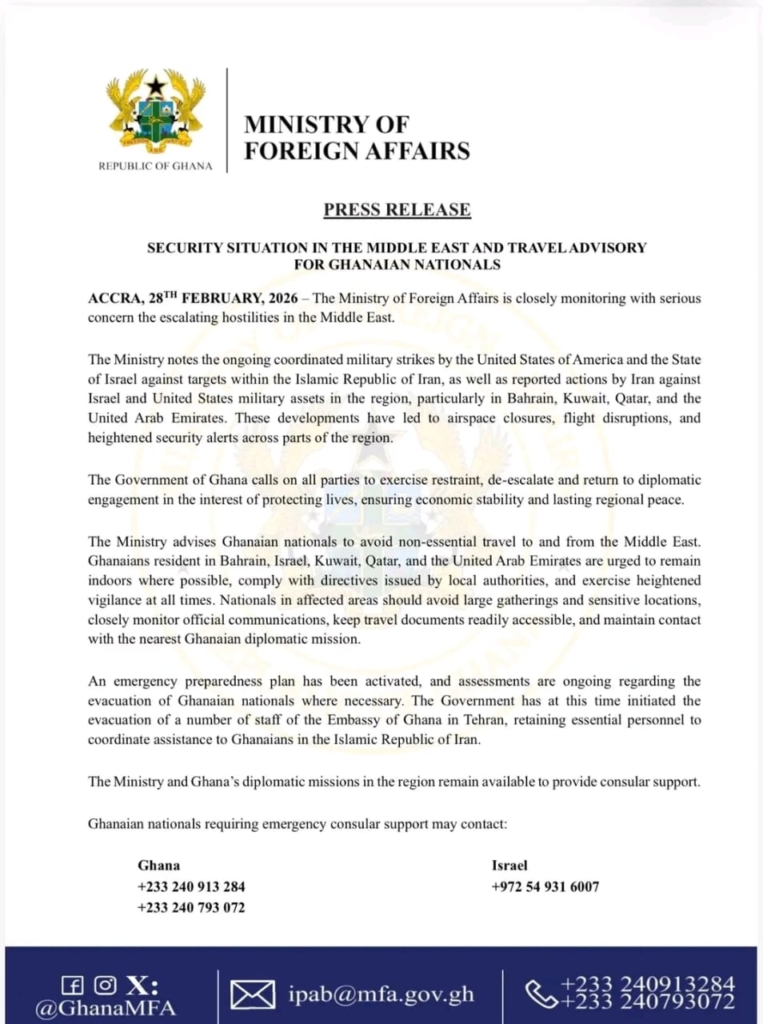
In an official press release issued on February 28, 2026, the Ministry said it was “closely monitoring with serious concern the escalating hostilities in the Middle East” and was already assessing whether full evacuations of Ghanaian nationals would be necessary.
“An emergency preparedness plan has been activated, and assessments are ongoing regarding the evacuation of Ghanaian nationals where necessary,” the Ministry stated, adding that the Government had “at this time initiated the evacuation of several staff of the Embassy of Ghana in Tehran, retaining essential personnel to coordinate assistance to Ghanaians in the Islamic Republic of Iran.”
The Ministry urged all Ghanaian nationals across the affected countries to remain indoors, avoid large gatherings and sensitive locations, comply with directives from local authorities, keep travel documents accessible, and maintain contact with the nearest Ghanaian diplomatic mission.
All Ghanaians were also advised to avoid non-essential travel to and from the Middle East until further notice.
On February 28, the United States and Israel carried out a series of joint military strikes on Iran, with explosions reported in central Tehran.
The attacks followed the largest US military buildup in the Middle East since the 2003 invasion of Iraq, with two aircraft carriers — including the USS Gerald R. Ford — deployed to the region.
Iran’s retaliation was swift and wide-ranging, targeting US military assets across the Gulf. The US Embassy in Abu Dhabi and the US Consulate in Dubai both issued shelter-in-place alerts for all staff, urging Americans in the UAE to take cover until further notice. Qatar, home to the US Central Command’s regional headquarters at Al-Udeid Air Base, was among the hardest hit — and had already prompted Ghana’s Doha Embassy to issue its own shelter-in-place advisory to Ghanaians earlier in the day.
This is not the first time Ghana has had to move fast to protect its citizens caught in the Iran-Israel conflict.
When an earlier wave of hostilities escalated in June 2025, Ghana closed its Tehran embassy and successfully evacuated the first group of Ghanaian nationals to Turkey by June 20, 2025, following intense diplomatic engagements with both Iranian and Israeli ambassadors.
Foreign Affairs Minister Samuel Okudzeto Ablakwa personally coordinated that effort, covering Ghanaian diplomats, students, professionals, and other compatriots evacuated via land borders.
Ghanaians requiring emergency consular support may contact the Ministry on +233 240 913 284 or +233 240 793 072, or reach the Ghana Embassy in Israel on +972 54 931 6007. All Ghanaians in affected countries are urged to register with their nearest diplomatic mission immediately.
About the Author
