Ifunanya Nwangene was asleep last Saturday morning in her ground-floor apartment in Nigeria’s capital city when she was awoken at around 08:00 by a searing pain on her wrist.
“A snake came up on her bed and bit her,” Ifunanya’s father Christopher Nwangene told the BBC’s Newsday programme.
He was relating the events that led to his daughter’s tragic death, which has raised serious concerns about how hospitals deal with snakebites, and the availability of antivenom across Nigeria, which has the world’s third-highest incidence of snakebites.
Ifunanya, a well-known soprano singer in Nigeria – finding fame a few years ago on the local version of the TV competition The Voice, knew she had to get antivenom at a hospital as soon as possible.
Her father said she also applied a tourniquet, tying a piece of rope tightly around her arm.
This used to be the recommendation for snakebites to stop the venom spreading through the body – though this is no longer the advice as a tourniquet, which stops the flow of blood, can cause tissue damage and increase the risk of amputation.
Instead, snakebite victims are told to keep calm, immobilise an affected limb and seek emergency medical care immediately.
But it is hard not to panic when one arrives at a hospital to find there is no antivenom, which happened to Ifunanya, meaning she had to go to another one.
The 26-year-old singer phoned her father when she later got to Abuja’s Federal Medical Centre, Jabi – and he then called his brother, who lives in the capital, to go and check on her.
She was not in a good way when her uncle got to the hospital – her tourniquet had been removed and she was put on a drip.
“Immediately they gave her the drip, the little girl started going down immediately. She said: ‘Daddy, I cannot speak,’” Nwangene recalled.
Ifunanya’s close friend, Sam Ezugwu, had also rushed to the hospital when he heard the news and told the BBC that some antivenom had been given to her, but more was needed.
“While they were trying to stabilise her, she could not speak but she could make hand gestures. She was struggling to breathe,” said Ezugwu, who is music director of the Amemuso Choir where Ifunanya sang.
He went out looking for another vial of antivenom – as did her uncle.
This version of events has since been disputed by the Federal Medical Centre, Jabi, which has denied the antivenom was unavailable and said claims its response was inadequate were unfounded.
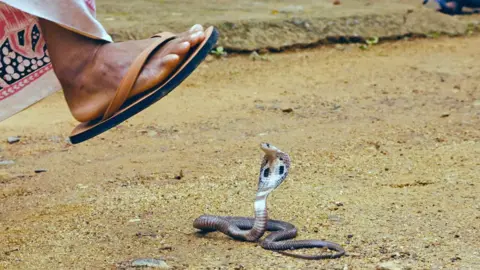
In Nigeria what is known as a “polyvalent antivenom” is usually used to treat snakebites, which means it can be used for bites from a variety of snakes.
The amount needed depends on the severity of the bite and the type of snake – with a vial currently costing between 45,000 naira ($33; £24) and 80,000 naira ($58; £43).
“They asked my brother to go and buy antivenom from [a] pharmacy,” Nwangene said, explaining that he had to go to several places.
But when he found some, it was too late. Ezugwu also returned with a vial to find Ifunanya had died.
Nwangene feels the hospital authorities did not do enough for his daughter – and questions why they removed the tourniquet if they did not have the medication to treat her.
“They’re not supposed to remove that thing. She has two hands,” he said, expressing the view that an amputation is better than death.
“They were not serious initially, as my brother told me. They were not serious at all.”
Her death has prompted widespread grief and urgent questions about the country’s readiness to tackle a persistent and lethal public health issue.
It has also shocked a nation where snakebites are often perceived as a rural danger.
Another of the singer’s friends told the BBC that two snakes were later found in her apartment in an upmarket area of Abuja.
Videos circulated online showing a snake handler removing one of the long black snakes that had slithered into the building – with onlookers screaming.
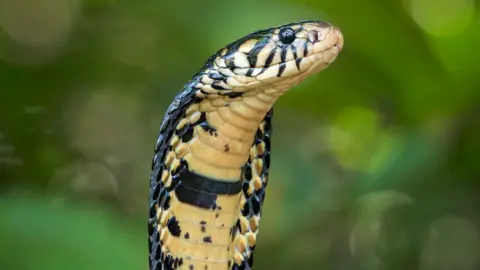
It is seen raising its hood, revealing it to be a cobra – and its colouring suggests it was a forest cobra, which, according to the African Snakebite Institute, is one of 12 highly venomous species of snakes found in Nigeria.
In 2021, Nigeria’s then-Health Minister, Olorunnimbe Mamora, stated that an average of 20,000 snakebites were recorded each year in the West African nation, describing the situation as having reached “epidemic proportions”.
The crisis is compounded by a critical shortage of affordable antivenom, which needs to be stored in fridges – often impossible in areas with unreliable electricity.
Shuaibu Mohammed, who lives in the north-eastern state of Gombe, said he was lucky to survive a snakebite 15 years ago.
He was at boarding school when he stepped on a cobra in the playground. He was rushed to hospital, which luckily had enough antivenom to treat him.
But three years ago, the outcome for his sister Sadiya, a mother of two, was fatal.
“It was in the night – and she came out to use the toilet when the snake bit her,” he told the BBC.
“We rushed her to the hospital but there was no antivenom,” he told the BBC.
“We were told we could buy some from the neighbouring state of Plateau. We called a brother there to get it, but before the antivenom was transported to us, we lost her,” he said.
It is a story Hafiz Aminu, from the northern state of Kaduna, knows all too well.
“I almost lost my life last year,” the 36-year-oldtold the BBC.
“I was returning home after a football game when a cobra bit me. But when we got to the nearest hospital, we were told they didn’t have any antivenom.
“So we quickly decided to seek traditional help from a healer.”
The herbalist gave him a concoction made from the bark of a plant – likely to have been that of the African custard apple, which is commonly used as a traditional medicine in Nigeria to treat snakebites.
A 2005 study published in the peer-reviewed Journal of Ethnopharmacology showed the relative effectiveness of the rootbark of this plant in treating cobra venom on rats, stating that it helped reduce fevers and “directly detoxified the snake venom used by 16-33%”.
Aminu said the herbalist rubbed some of the mixture on his foot, where he had been bitten, and he was told to drink the rest with the warning that it would make him feel nauseous.
“I was feeling very weak and was scared for my life. When the healer saw me two days later, he said I was lucky to be alive.”
The African Snakebite Institute warns that traditional remedies are not known to work against highly venomous snakes.
Experts point out that the widespread use of traditional healers for snakebites means that the true scale of the problem is not known, as many deaths will go unrecorded.
In response to Ifunanya’s death, the Nigerian Senate has called on the health ministry and the National Agency for Food and Drug Administration and Control (Nafdac) to ensure the nationwide availability of safe, effective and affordable antivenoms.
However, the motion did not set a specific timeline for action.
“A snakebite kills one person every five minutes,” said Elhadj As Sy, chancellor of the Liverpool School of Tropical Medicine (LSTM) and co-chair of the Global Snakebite Initiative.
He called on governments to integrate snakebite treatments into core health strategies and ensure that antivenom was accessible.
“With real political commitment we can end these preventable deaths,” he told the BBC.
There have also been breakthroughs that may one day lead to more affordable solutions.
Scientists from LSTM and the University of Sydney announced in 2024 that the blood thinner heparin could be repurposed as an inexpensive antidote for cobra venom.
At the time, University of Sydney’s Prof Greg Neely envisaged it had the potential to be used like an EpiPen, a device carried by people with allergies at risk of death from anaphylactic shock. It delivers a shot of adrenaline, while a snakebite pen could inject heparin.
For Nwangene, medics on the frontline in Nigeria need more “human sympathy” when dealing with snakebite victims.
He added that Ifunanya’s gifted voice had given him great happiness over the years.
“My daughter is a very, very gentle girl. When she was growing up, she has been singing in our church – very, very, very talented.
“Every morning when I wake up, I thank God on her for giving me such a child until this wicked world took her away from me.”
About the Author