Canada is set to open its first diplomatic outpost in Greenland in a significant show of solidarity following US President Donald Trump’s threats to take control of the territory.
A delegation of senior Canadian officials, including Governor General Mary Simon, and foreign minister Anita Anand, are travelling to Nuuk on Friday to formally open Canada’s consulate, accompanied by a Canadian Coast Guard ship.
Ahead of the trip, Simon said in a speech that Canada “stands firmly in support of the people of Greenland who will determine their own future”.
Their visit comes amid a similar trip made by French officials, who are due to open their own consulate in the territory the same day.
The Canadian and French missions are a historic expansion of foreign engagement in Greenland. Until this week, only Iceland and the US had formal diplomatic consulates in Nuuk.
It is also a signal of the continued support offered by Nato allies to Greenland, after Trump repeatedly stated that the US needs to “own” it for national security reasons.
The president has since walked his comments back, saying he is now exploring a potential deal after talks with Denmark, European allies and Canada.
Greenland has been on Canada’s radar for some time. The consulate was first announced in early 2024, when Ottawa reviewed its Arctic foreign policy. The opening had been slated for late 2025, but that was delayed due to bad weather.
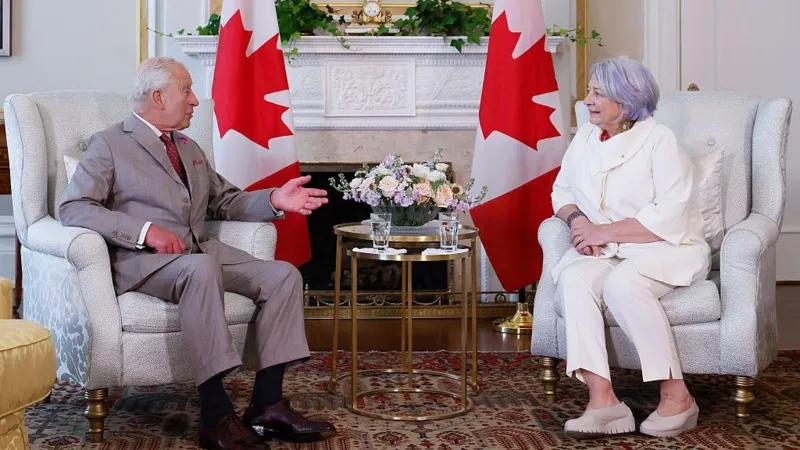
Now, the consulate carries even more weight, said Michael Myers, a professor at the University of British Columbia who has authored several books on the Arctic.
“I’m only surprised it hasn’t occurred sooner, given the important connections between Greenland and Arctic Canada,” he added.
He noted that Iqaluit, the capital of Canada’s northern territory of Nunavut, is only an hour flight away from Nuuk. Inuit in Canada also share a strong bond with Greenlandic Inuit – a bond underscored by Governor General Simon’s own Inuk roots.
“Her visit is an affirmation at the highest level of the cultural and ethnic connections between Arctic Canada and Greenland,” Myers said. “It’s a very powerful statement.”
Simon, who grew up in Nunavik in northern Quebec, is the first Canadian governor general to visit Greenland since 1982. But her exposure to the Arctic territory began decades ago, she said, when she would hear Greenlandic Inuit songs as a child through her grandmother’s shortwave radio.
“She would say: ‘These are our relatives who live in faraway lands. We are all one people,’” Simon recalled at the annual Arctic Frontiers conference this week in Norway, shortly before her trip to Nuuk.
Natan Obed, president of Inuit Tapiriit Kanatami, which represents Canadian Inuit, told the BBC that the consulate is the result of years of advocacy by his community to forge closer ties.
Obed said that around 50 Canadian Inuit will be arriving on a chartered plane from Montreal to Nuuk to attend Friday’s ceremony.
Inuit in Canada, he said, feel the US threats against Greenland intimately due to their shared history of colonisation, as well as Trump’s own comments about Canada.
“We do worry that the United States may return to its more serious overtures around annexing Canada and Canada being the 51st state, and we do worry that Inuit Nunangat, our homeland, is one of the pivotal reasons for the US to consider that sentiment,” Obed said.
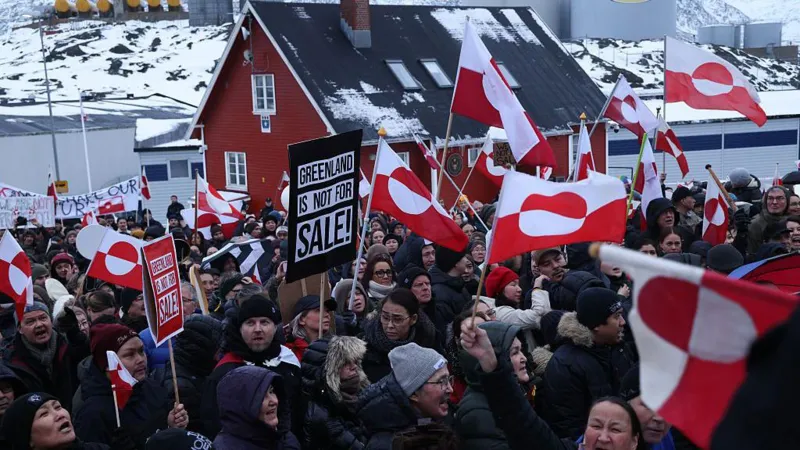
Trump has justified a US takeover of Greenland by blaming Denmark for failing to adequately protect the island from Russian or Chinese threats.
He has privately made similar complaints about Canada’s Arctic region in recent weeks, according to a NBC News report published in mid-January.
The Arctic has been flagged as a vulnerability by successive Canadian governments, and Obed acknowledged that infrastructure there, like highways and electricity connections, remains limited, to the detriment of both national security and those who call the northern regions home.
Prime Minister Mark Carney’s government has promised a year-round military presence in the Arctic and pledged more than C$1bn ($730m; £540m) for northern infrastructure projects that would be used by both civilians and the military.
Foreign minister Anand has called Arctic defence “an unquestionable national security priority of this government”.
“It is not a secondary concern, it is not a regional issue, but central to how we protect Canada in our front yard and how we contribute to global security,” she said at a Nordic-Canadian Arctic Symposium last week.
Along with the opening of the Canadian consulate, Governor General Simon will also be meeting with Greenland’s Prime Minister Jens-Frederik Nielsen, while Anand will meet with her counterpart Vivian Motzfeldt.
About the Author