
Ghana has urged African leaders to rally behind a bold push for $100 billion in annual climate adaptation and mitigation finance, warning that the continent cannot shoulder the escalating burden of climate impacts alone.
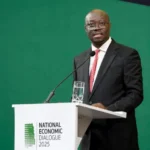
Alhaji Baba Seidu Issifu, the Minister of State for Climate Change and Sustainability, delivered the call in Nairobi on behalf of President John Dramani Mahama, at the African Leaders’ Meeting on Climate Adaptation, chaired by Kenyan President William Ruto.
He conveyed warm greetings from President Mahama, noting that the President “strongly aligns with the objectives of this critical meeting” despite being unable to attend.
He said Africa was facing “unprecedented climate impacts such as droughts, floods and rising temperatures, which threaten lives, livelihoods and our developmental gains.”
The outcome of COP30 in Belem, Brazil, showed that Africa must “act decisively” to confront the climate crisis, he said.
Alhaji Issifu stressed that climate adaptation is a development imperative, not an optional priority for the continent.
He called on African states to unlock “high‑impact opportunities for resilient‑driven growth,” leveraging climate finance, multilateral partnerships and private‑sector engagement.
He described the Africa Adaptation Acceleration Programme (AAAP2.0) as “a beacon of hope,” urging leaders to work collectively to secure firm financial commitments.
He said the call for financing was not theoretical. “The need for this call became more critical at the just‑ended COP30 in Belem, where adaptation negotiations took a difficult turn,” he said.
He criticised the revised Global Goal on Adaptation text, which reduced indicators from 100 to 59, saying it was “widely viewed as a step backwards.”
Many parties questioned its technical soundness and the opaque process that produced it, he said, warning that this had created “trust deficits at this crucial moment.”
Although Parties eventually reached an agreement, Alhaji Issifu noted that the overarching text contained notably weak Loss and Damage language, with no reference to the scale of needs or financing.
He added that climate‑finance discussions “remained fragmented,” and that the proposed Article 9 work programme still failed to provide developing countries with a defined space to discuss delivery of public finance under the new goal.
The broader finance package, was still insufficient to close the widening gap between needs and delivery, he said.
Turning to domestic efforts, he said Ghana was integrating climate resilience into national development plans, expanding green‑job opportunities and advancing its 24‑hour economy, which prioritises sustainability.
“Ghana’s 24‑hour economy agenda prioritises green growth, renewable energy, and sustainable infrastructure,” he said. “We are investing in solar, hydro and smart agriculture to power our future.”
But he acknowledged challenges, including high costs, limited technology access and unfair trade practices.
“This means that Ghana, and for that matter, individual African countries, cannot do it alone,” he said. “We need peer and global support, fair financing and appropriate technology transfer.”
He highlighted Africa’s disproportionate burden, noting that the continent contributes less than 4% of global emissions yet suffers the worst climate impacts.
“This injustice must end,” he said. “We need fair, accessible climate finance – not debt, not aid, but partnership.”
The minister said the AAAP2.0 offers a roadmap for a climate‑smart Africa but requires resources.
“The AAAP2.0 is our chance to leapfrog into a resilient future. Let us mobilise $100 billion annually for African adaptation and mitigation. Let us make climate action a catalyst for Africa’s industrialisation,” he said. He urged partners to match pledges with action.
Calling for a bold communiqué, he said Africa must show the world that “its climate resilience is non‑negotiable.” He reaffirmed Ghana’s commitment to continental and global climate action.
“To our youth, our future leaders: this is your moment. Engage, innovate and lead climate action in your communities,” he said.
“Ghana and Africa are ready to collaborate, to co‑create solutions and to drive sustainable growth.”
He urged participants to leave the meeting with a clear roadmap that Africa’s resilience was non‑negotiable and that the time for action was urgent.
About the Author
