
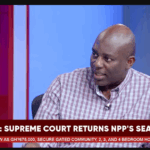
Dr John Osae Kwapong, Democracy and Development Fellow at the Centre for Democratic Development (CDD-Ghana), says he was surprised by the High Court’s decision to annul the Kpandai parliamentary election, arguing that the court should have limited its remedy to the specific polling stations where irregularities were identified.
Speaking on Newfile, Dr Kwapong questioned why the trial court opted for a complete rerun instead of addressing only the problematic areas.
“If there are legal infractions, then your remedy is where those legal infractions or errors occurred, then you go there, and you fix it,” he said. “When I looked at the Kpandai ruling, I was quite surprised… There was no dispute about the fact that certain polling stations and their results were problematic.”
“So I was not sure why the judge’s remedy then was to throw the whole thing out and have a do-over, as opposed to let’s just remedy the problematic areas,” he added.
His comments come in the wake of a recent Supreme Court ruling that overturned the High Court’s earlier decision to annul the election of New Patriotic Party (NPP) Member of Parliament for Kpandai, Matthew Nyindam.
In a 4–1 majority decision, the apex court restored Mr Nyindam’s victory after upholding his application invoking the court’s supervisory jurisdiction. He had challenged the High Court’s ruling because it was based on a jurisdictional error.
Justice Gabriel Scott Pwamang, who presided over the panel, dissented.
The Supreme Court held that the High Court lacked jurisdiction to hear the election petition because it was filed outside the legally mandated timeframe.
At the centre of the dispute was the date on which the Electoral Commission (EC) gazetted the results of the 2024 parliamentary election in the Kpandai constituency.
Under Ghana’s electoral laws, an election petition must be filed within 21 days of the gazette notification of results. Any petition filed after that period is considered invalid and cannot be entertained by the court.
The High Court had earlier annulled the election, citing irregularities in some polling stations and ordered a fresh poll in the constituency. That decision sparked legal and political debate, particularly within the NPP.
Dr Kwapong said while concerns about flawed results must be taken seriously, courts must also apply remedies that are proportional and legally sound.
He noted that where irregularities are limited, the focus should be on correcting those specific issues rather than invalidating an entire election.
About the Author
