
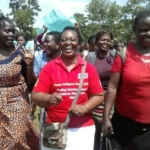
Colonialism did not merely exploit African women; it transformed them into permanent infrastructure for empire. African women’s bodies became sites upon which economic, social, and political systems were built, maintained, and stabilised. Their labour in fields, homes, and communities functioned as the invisible architecture supporting colonial expansion and capitalist accumulation.
This article argues that African women were not only workers within colonial systems but structural components of those systems, forcibly positioned to absorb economic shock, reproduce labour, and sustain social order. “Women were forced to work in mostly of the farms in Europe, supporting men, being abused sexually, brutally killed and mistreated while being exhibited as sex tools in Europe”.
Central to this important conversation was the discussion organised by the Pan-African Progressive Front with Margaret Mbira, a human rights activist based in Kenya. Margaret Mbira works with the World March of Women, an international human rights organisation that advocates for social justice, gender equality, and the dismantling of systems that exploit and marginalise women, particularly in the Global South. Through her activism, Mbira has consistently centered the experiences of working-class and grassroots women, linking struggles against patriarchy to broader fights against imperialism, economic exploitation, and structural inequality.
With her thoughts on “The Matriarchal Debt from the Capture of Female Labour,” Mbira brings a critical Pan-African and feminist perspective to the reparations discourse. She highlights how African women’s labour, both productive and reproductive has been historically exploited under slavery, colonialism, and contemporary capitalist systems, while remaining largely unacknowledged and uncompensated.
In the discussion, advocate Mbira acknowledged that transformation was the weaponisation of reproductive labour. Enslaved and colonised African women were compelled to reproduce populations that could be exploited, while also sustaining daily life through food production, care-giving, and community maintenance. Their wombs became economic assets controlled through violence, law, and social coercion.
This reproductive exploitation ensured the continuity of the labour supply while denying women autonomy over their own bodies and futures. Such practices were neither accidental nor culturally neutral; they were strategic mechanisms of domination embedded in colonial governance. “Women were extracted and exploited to sustain slavery and colonial economies”, she began. “A lot of the work done in the colonial system was done to sustain the colonial masters and a lot of this work was done by women.”
Domestic labour further entrenched African women’s role as infrastructure. In colonial households, African women cooked, cleaned, cared for children, and provided emotional stability to colonial administrators and settlers. This labour enabled colonial officials to function efficiently while eroding African women’s own family structures and social standing. By framing domestic labour as natural female duty, colonial systems concealed its economic value and normalised its exploitation. Mbira explained as she spoke about the aftermath of Maafa.
The afterlife of this colonial gender economy persists in post-independence states that continue to rely on women as economic shock absorbers. Structural adjustment programs, austerity policies, and neoliberal reforms have disproportionately increased women’s unpaid care burdens while excluding them from formal employment and political power. Women continue to stabilise economies during crises through informal labour and community support, replicating the infrastructural role imposed during colonialism. “Post-colonial, it is the same. Compensations were not given to women and still aren’t”, she ended.
Reparations must be executed as a strategic instrument to dismantle the structural positioning of human beings as mere expendable infrastructure for global capital. This is not a request for charity, but a mandate for the total deconstruction of systems that categorise life as a secondary resource. Genuine justice through this lens requires a systemic transformation that transitions the collective from being the “engine” of an empire to being the master of its own destiny.
To achieve this, the reparations framework must be anchored in radical public investment, the redistribution of land, and the establishment of sovereign economic governance. It is a process of reclaiming the wealth generated by uncompensated labour and reinvesting it into the foundational systems of care and production that sustain a society. These interventions are the necessary material components of a debt that has been accumulating for centuries and remains due in full.
On the topic of dismantling structures, Advocate Mbira suggested outlined frameworks necessary to begin this re-structural process; “Women must secure land ownership and inheritance rights, compensations and social protection for unpaid care and labour, and also investing in women where agriculture, economies and cooperatives are concerned. This is then, be a stepping stone away from the colonial exploitation of women that challenges us even till this day.”
And for Pan-African organisations like PPF, Margaret Mbira urges that organisations “educate our African people”. She states in this case, the importance of popular education to all, where we learn about our culture and history from one another. “Specifically, for PPF, I would say, the job being done is commendable. The torch must only be held high and our voices heard far beyond boarders.”
And for the PPF, through its ongoing analysis of reparations and the matriarchal debt, is the sharpening a political truth long ignored: the struggle for reparations cannot be separated from the struggle for women and youth justice. By this reason, PPF structures this work through two interconnected departments; one dedicated to Women and Youth, and the other to Reparations. Both of these departments are actively working to ensure these issues remain at the center of Pan-African discourse, organising, and mobilisation.
The Women and Youth Department, led by Richmond Amponsah, addresses how colonialism, capitalism, and patriarchy have jointly marginalised women and young people while extracting their labour, creativity, and futures.
“I will begin by exposing that the new age of digital imperialism should not be one that distracts us from what we fight for today. It should be a tool we leverage on to demand for compensation of extracted labour and stolen resources, particularly that of the matriarchal debt owed to our African mothers, sisters and daughters.”, he shared.
On the reparations front, Sumaila Mohammed, head of the Reparations Department and PPF’s blogger, leads critical interventions that frame reparations not as charity, but as justice owed. His work situates reparations within historical crimes against African peoples, with special attention to the unpaid and erased labour of our African people.
“I honestly believe that, the task undertaken by the PPF, will one day become a part of a broader framework used by the continent as reference to gain our Reparative justice.”, and for him, must be critically approached, he reiterated.
The connection between these two departments reflects a deeper political reality: a large number of women were the backbone of African societies before, during, and after colonial conquest. Their bodies, labour, and social roles were systematically exploited to sustain colonial frameworks. Addressing Reparations and not including women and youth would mean repairing structures while leaving their foundations broken. PPF’s work insists that true repair must restore dignity, power, and agency to those most exploited.
In concluding “When we talk about matriarchal debt, we look closely even in our own context and analyse, how well are women’s labour and efforts recognised on our time? How often do we solidarise with issues pertaining women?” Mbira asked, as she left the room with a deep sense of consciousness.
African women are not infrastructure; they are architects of survival and builders of nations. Reparations must restore their autonomy, authority, and rightful place at the center of economic life.
Ultimately, reparations are not merely about correcting historical grievances; they are about terminating an ongoing system that views people as tools of extraction rather than sovereign economic actors. By shifting the global paradigm from “aid” to “restitution,” we end the cycle of exploitation and begin the era of absolute self-determination. Reparations are the final act of closing a predatory ledger and opening a future defined by autonomy, dignity, and total repair.
Princess Yanney
Journalist, Writer & Media Analyst
F Tuyee Lane, Tema, Ghana
About the Author
