
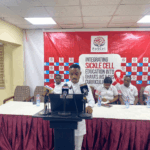
The Founder of the Focus on Sickle-Cell Foundation (FosCel), Mr Amos Andoh, has called for the integration of sickle cell education into Ghana’s Junior High School (JHS) and Senior High School (SHS) curriculum.
He described knowledge as “the first medicine” in the fight against the disease.
Speaking at a national press conference held on Monday, January 19, at the Ghana Journalists Association (GJA) Press Centre in Accra, Mr Andoh said the advocacy was deeply personal, as he himself lives with sickle cell disease.
“I stand before you today not only as the founder of FosCel but also as a young person living with sickle cell disease. This advocacy is not just professional; it is personal and purposeful,” he stated.
“My life has taught me one clear lesson: knowledge protects life, and early awareness changes destiny.”
The press conference, which was held under the theme, ‘Integrating Sickle Cell Education into Ghana’s JHS and SHS Curriculum’, served two key purposes.
First, FosCel commended the Government of Ghana, particularly the Ministry of Health, for the launch of the National Sickle Cell Strategy 2024–2028 and the National Sickle Cell Disease Screening and Case Management Guidelines, unveiled in December last year, as well as earlier initiatives such as free sickle cell treatment.
Secondly, FosCel formally presented a policy proposal advocating for the inclusion of structured sickle cell education within Ghana’s school system, in alignment with the national strategy.
According to Mr Andoh, about 2 per cent of newborns in Ghana – nearly 18,000 babies – are born with sickle cell disease every year.
“These are not statistics. These are children. These are families. These are futures,” he stressed.
Yet he noted that many students complete basic and secondary education without understanding genotype, inheritance patterns, or how informed choices can prevent suffering.
“While treatment saves lives, we believe education prevents pain before it begins,” he said.
Mr Andoh explained that FosCel’s approach, dubbed “Catch Them Young”, focuses on introducing age-appropriate sickle cell education at the JHS and SHS levels to empower young people to make informed health decisions before marriage and parenthood.
This, he said, would complement national policy by translating it into classroom practice.
To support this vision, FosCel has developed an innovative sickle cell comic strip education model that uses storytelling and illustrations to simplify concepts such as genotype inheritance, early screening, prevention and stigma reduction.
The model has been piloted in schools, churches, mosques and community settings in the Efutu Municipality, Winneba, and other areas, receiving positive feedback from both students and teachers.
“For many young people, this was their first structured exposure to sickle cell education in a relatable format,” Mr Andoh noted.
He proposed that the Ministries of Health and Education, together with the Ghana Education Service, adopt and scale the comic strip model nationwide to support implementation of the National Sickle Cell Strategy in schools.
He added that even before formal curriculum integration, the comic strip initiative could equip students, especially those nearing completion of school, with essential knowledge about their genotype.
Highlighting FosCel’s grassroots work, Mr Andoh said the foundation has organised awareness and screening programmes in schools, churches, mosques and communities, including a national event at the University of Education, Winneba, during World Sickle Cell Awareness Day 2025, in collaboration with local health centres.
“These interventions show that school-based education is a powerful tool for breaking myths, promoting early screening and reducing stigma,” he said.
Mr Andoh described the harsh realities faced by sickle cell warriors, including stigma, organ damage, strokes at a very young age, and the high cost of treatment.
He welcomed the inclusion of sickle cell treatment under the National Health Insurance Scheme (NHIS), describing it as “a very powerful approach” that offers relief to affected families.
“Imagine living with a condition where medication alone can cost over GH¢500 a month, and hospital admissions during crises can exceed GH¢2,000,” he said, citing the high cost of pain medications such as pethidine and tramadol.
Despite the challenges, Mr Andoh emphasised that people living with sickle cell disease have aspirations and the capacity to contribute meaningfully to national development.
“We have sickle cell warriors who dream of becoming doctors, journalists, Members of Parliament, even presidents,” he said. “This condition should not define or limit our future.”
He urged stakeholders to support the integration of sickle cell education into Ghana’s school system, alongside existing health topics such as HIV and AIDS, malaria and reproductive health.
“Let our classrooms teach what our hospitals treat,” Mr Andoh said. “Let knowledge become our first medicine.”
He thanked the media, the Ghana Journalists Association, and the Ministries of Health and Education for providing a platform to present FosCel’s proposal, expressing hope that Ghana would move from policy to practice in sickle cell education.
“For the sake of our children and our nation’s future, we must act now,” he added.
About the Author
