
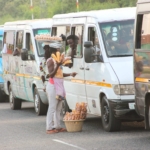
Every morning in Accra, thousands of people leave home without knowing one simple thing: when they will actually arrive.
Queues stretch endlessly at stations. Departure times are uncertain. Seats are never guaranteed. By the time many commuters reach work or school, they are already drained.
This is the everyday reality of urban transport in Ghana’s capital. Not just congestion, but unpredictability.
Earlier last year, Swift, a Ghanaian transport startup, set out to test a simple idea: what if people could rely on transport the same way they rely on a calendar?
Swift first gained national attention after winning a prize at the MTN MoMo Hackathon in, where its approach to digital ticketing and structured transport stood out.
That momentum later helped the company secure a place in the Ashesi Venture Incubator (Cohort 7), which supports early-stage ventures building scalable, locally relevant solutions.
As part of that journey, Swift partnered with Ashesi University’s Student Council to run a live shuttle pilot focused on reliability rather than volume.
The service offered scheduled trips, fixed pickup points, reserved seating, and app-based booking with mobile money and card payments.
The response was immediate
During the pilot, Swift onboarded over 400 riders, completed more than 50 scheduled trips, and sold over 450 tickets. More importantly, riders began planning their days differently. No rushing to stations. No waiting to see if a bus would fill up. No standing for long journeys.
“It wasn’t about luxury,” one rider explained. “It was about knowing I’d leave on time and get a seat.”
The pilot revealed something important: many commuters are not necessarily looking for faster roads or bigger buses. They want certainty.
Swift does not aim to replace existing transport systems. Instead, it focuses on adding a layer of predictability to key corridors and institutional routes where time and reliability matter most.
As Accra continues to grow outward, questions about how people move reliably, not just cheaply, are becoming harder to ignore. Swift’s Ashesi pilot suggests that even modest, well-run systems can meaningfully reduce daily transport stress without major infrastructure investment.
The challenge now is scaling responsibly. But the signal is clear: when transport works on time, people reorganize their lives around it.
And that may be the most powerful innovation of all.
About the Author
