
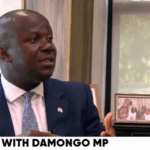
The Member of Parliament for Damongo, Samuel Abu Jinapor, has called on Ghanaians and members of the New Patriotic Party (NPP) to shun politics based on religion and ethnicity, describing such approaches as outdated and divisive.
Speaking in an interview on JoyNews while discussing the NPP flagbearer race and why he believes Dr Mahamudu Bawumia is the party’s strongest candidate, Mr Jinapor said arguments rooted in tribe or religion have no place in modern Ghanaian politics.
“It is most unfortunate for any Ghanaian, and any member of the NPP for that matter, to proceed on a tangent of the politics of ethnicity and religion. It’s most unfortunate. It’s backward. If I may be blunt about it, it’s totally backward,” he stated on Thursday, January 15.
According to him, those pushing such narratives are failing to understand how Ghanaian society is changing, especially among the youth.
“People are misreading our country. Things are moving very fast, and a lot of people today, particularly the youth, are moving quickly beyond these divisive politics of where someone comes from or what religion they practise,” he said.
Mr Jinapor said he was encouraged by what he described as a growing rejection of such politics and called for an even faster shift away from them.
“I am encouraged that the movement away from that kind of politics is very fast, and I think it should even be faster,” he said.
He said that what matters most to Ghanaians are practical issues that affect their daily lives.
“What people are very interested in are the concrete issues which confront them. Issues of employment, issues of healthcare, issues of infrastructure, issues of prosperity, and the cost of living. These are the germane issues confronting the people as we speak today.”
The Damongo MP also said that Ghana’s history shows a consistent ability to rise above ethnic and religious divisions, particularly during national elections.
“I am very clear in my mind that Ghanaians have demonstrated, when you look at the history of our country, that we rise above ethnicity and petty divisions when it comes to religion,” he said.
“All of us are married to people of all sorts. We are friends across the country, of all kinds and of all religions,” he added.
Mr Jinapor rejected the idea that a candidate’s ethnic background or religious affiliation should influence voting decisions in a national election.
“The suggestion that because somebody comes from a particular ethnic group, or worships a certain God, or is a Muslim or a Christian, it will necessarily matter in a national election is something I totally reject. I think Ghana is way above that.”
While acknowledging that a small minority may still be influenced by such considerations, he insisted that they do not represent the broader national character.
“Yes, you may have a tiny minority who may be motivated by some considerations. But by and large, when all is said and done, the character of Ghana rises above sectarianism, sectionalism, religion, and ethnicity,” he said.
Mr Jinapor said this unity explains why Ghana has remained peaceful compared to many other countries on the continent. “That is why Ghana holds one of the most enviable records in Africa, having never experienced a civil war, because we are one people,” he said.
He added that shared national values and traditions continue to bind Ghanaians together.
“It doesn’t matter where you come from or your religion. When it’s Christmas, we all celebrate it. When it’s a holiday, we all celebrate it. Wherever you go in Ghana, you are welcomed,” he noted.
He said that religion and ethnicity should never be factors in choosing the NPP’s presidential candidate.
“That argument is totally rejected and should never be a consideration for electing the presidential candidate of the NPP,” he observed.
About the Author
