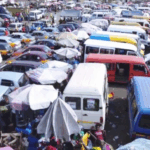
While commuters in Ghana’s capital endure grueling daily traffic, it has emerged that the state is sitting on over €2.4 million worth of unutilized transport and spatial development plans.
In a disclosure on Joy FM’s Super Morning Show on Thursday, January 15, 2026, Mr. Benedict Arkhurst, the Head of Plan Preparation at the Land Use and Spatial Planning Authority (LUSPA), revealed that comprehensive solutions to Accra’s transport crisis were fully developed nearly a decade ago but have been largely ignored by successive administrations.
According to Mr. Arkhurst, the government, with international backing, heavily invested in diagnostic frameworks intended to revolutionize national and urban mobility.
These documents were not mere suggestions but high-level strategies prepared by experts to address the very congestion currently paralysing the city.
The investments include:
- €2 Million National Spatial Development Framework: A macro-level plan designed to coordinate infrastructure across the country.
- $500,000 Accra-Specific Transport Plan (2017): A targeted blueprint for the Greater Accra Metropolitan Area (GAMA) focused on decongestion and urban flow.
“The government sponsored these plans for them to be prepared… what is now required is the political will and the commitment to say that we want to consciously solve the issue,” Mr Arkhurst stated.
Perhaps the most alarming revelation was the fast-approaching expiration dates of these multi-million-euro documents.
Many spatial plans are designed with 15-to-20-year lifespans, and with a decade already passed since their inception, their relevance is beginning to wane.
“Some of the plans have three years to expire… and we are almost 10 years through the implementation phase, but nothing has been done,” he bemoaned.
Mr. Arkhurst highlighted that these idle documents include not just road strategies, but also the Transport Master Plan and the Railway Master Plan, which together provide a multimodal solution to moving people and goods efficiently.
The LUSPA official did not mince words regarding the cause of the delay, attributing the stagnation to a lack of political will.
He noted that while the road network requires significant financial capital, more affordable “soft” solutions—such as reforming the public transport system—are already detailed in the plans but remain untouched.
“It is time to have the conversation; all stakeholders, come together,” he urged. “If it is the road network that we are not ready to resolve because it requires a lot of financial resources… from the public transport system, the solution is there.”
About the Author