
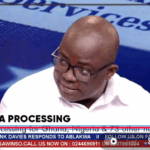
Political scientist and senior lecturer at the University of Ghana, Dr Joshua Zaato, has urged the government not to abandon the stalled Agenda 111 hospital projects, despite the financial irregularities uncovered by the Ghana Audit Service.
Speaking on the AM Show, Dr Zaato argued that while persons found culpable must be punished and public funds retrieved, the policy itself should not be sacrificed, stressing that completing the hospitals would significantly improve healthcare delivery and create jobs.
“By all means, retrieve the money, punish the perpetrators, but reinvest that money into completing this,” he said. “If we wake up one day and realise that these hospitals are completed, healthcare delivery in this country will massively improve.”
His comments follow revelations by the Ghana Audit Service that it has issued a surcharge against 35 contractors to recover $7.9 million, equivalent to about GH¢94.6 million, over unexecuted or poorly executed works under the Agenda 111 initiative.
According to the audit report, the contractors were paid mobilisation fees to work on 19 hospital sites. Out of the $11.16 million disbursed, the companies executed work valued at only $5.96 million. An additional $4.35 million was paid to 11 companies which completed inception works valued at just $2.49 million, leaving $1.92 million unaccounted for before their contracts were terminated.
Some of the contractors, the report said, failed to move to the site after receiving payments, while others completed less than 10 per cent of the value of the sums they received between December 2021 and December 2024.
Despite the controversy, Dr Zaato believes completing the hospitals remains critical to Ghana’s healthcare system and employment drive.
“Right now, there are thousands of nurses waiting to be posted. If we finish these projects, we can post them there—and that is what job creation is,” he noted.
He added that many allied health professionals across the country are also unemployed and would benefit directly from the operationalisation of the facilities.
Dr Zaato further pointed out that many Ghanaians continue to travel long distances to access basic healthcare services, a situation he believes could be drastically improved if the Agenda 111 hospitals are completed.
“My point is, let’s not sacrifice the policy. It doesn’t matter where it comes from,” he said, emphasising Ghana’s history of policy continuity despite political transitions.
Agenda 111, launched by the previous government, aimed to construct district hospitals, regional hospitals, and specialised facilities across the country to bridge gaps in healthcare access.
About the Author
