
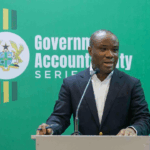
Minister in Charge of Government Communications, Felix Kwakye Ofosu, has confirmed that ten petitions filed against Special Prosecutor Kissi Agyebeng and the Chair of the Electoral Commission (EC), Jean Mensa, together with her two deputies, have been forwarded to the Chief Justice, Justice Paul Baffoe-Bonnie, for review.
Speaking at the Government Accountability Series in Accra on Wednesday, January 14, Mr Kwakye Ofosu clarified that the President’s role in the matter ends once the petitions are transmitted to the Chief Justice.
“Unlike the petitions against the Chief Justice, the President’s mandate in respect of the petitions against the Special Prosecutor and the Electoral Commissioner and her two deputies ends with conveying the petitions to the appropriate quarter, which in this instance is the Chief Justice. That was done a couple of weeks ago,” he said.
He added: “A total of ten petitions were received, seven against the Electoral Commissioner and her two deputies and three against the Special Prosecutor. The President has no role beyond that, and in that regard, we cannot speak to it. The Chief Justice’s office may be in a good position to comment. The President will once again be called to act when the Chief Justice has determined prima facie.”
The petitions, submitted by various individuals and groups, allege misconduct. Those against the Special Prosecutor cite claims of incompetence and abuse of office, while the complaints against the EC leadership relate to accountability and the management of the Commission.
Under Section 16 of the Office of the Special Prosecutor Act, 2017 (Act 959), any petition seeking the removal of the Special Prosecutor must follow a defined legal process. The President is required to forward such petitions to the Chief Justice within seven days. The Chief Justice then has 30 days to determine whether a prima facie case has been established.
If a prima facie case is found, the Chief Justice is required to constitute a three-member committee to investigate the allegations and submit its recommendations to the President, who is bound to act on the findings.
Mr Agyebeng has served as Special Prosecutor since 2021, succeeding Martin Amidu. His tenure has drawn mixed reactions, with some praising the Office of the Special Prosecutor (OSP) for advancing accountability, while others argue it has, at times, fallen short of expectations.
Some legal practitioners have also publicly criticised aspects of the OSP’s work. Private legal practitioner Martin Kpebu, for instance, accused Mr Agyebeng of “extreme incompetence” over the handling of matters relating to former Finance Minister Ken Ofori-Atta.
About the Author
