
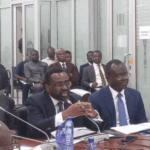
Dr Johnson Pandit Asiama, the Governor of the Bank of Ghana, Monday called for a unified national response to address losses arising from the Gold-for-Reserves programme.
Appearing before Parliament’s Public Accounts Committee (PAC) in Accra, he said the initiative remained critical to reserve accumulation, despite recording significant financial losses since its introduction in 2021.
Dr Asiama said the losses should not be seen as a basis for apportioning blame, but rather as an opportunity for collective reform.
“The losses should not be a source of blame but rather a rallying point for collective action. Our appeal is for a unified national approach. We want everyone to join in reforming the programme to sharpen efficiency and support economic stabilisation,” he said.
Dr Asiama explained that the Gold-for-Reserves (G4R) programme was designed to strengthen Ghana’s reserves and diversify the foreign exchange portfolio, but currently required the Central Bank to absorb certain costs not explicitly captured in its budget.
He told the Committee that total gold holdings under the programme had reached 110.99 tonnes by 2025, valued at US$11.399 billion.
The programme had recorded a cumulative net loss of GHS4.893 billion, comprising GHS1.054 billion in 2023 and GHS3.893 billion in 2024, while the 2025 figures were under audit, he said.
Dr Asiama said the programme was achieving its core objective but required further reforms to reduce costs, noting that the Bank of Ghana could no longer absorb all associated expenses.
He indicated that such costs should be captured in the national budget.
“The scheme was introduced to solve national problems. The question now is how to reform them and make them more efficient,” he said, adding that the Bank had already reduced some charges and was pursuing additional reforms.
He reiterated the relevance of the programme, stating: “The Gold for Reserves programme is still relevant. Its objective is to build reserves. Evidence shows that it is not a matter of shutting it down but rather enhancing efficiency and removing inefficiencies.”
Dr Asiama said budgeting for the programme’s costs as quasi-fiscal activities would further reduce losses and improve sustainability, enabling the model to operate more efficiently.
He announced that meetings had been scheduled with the Ghana Gold Board later in the week, with further stakeholder engagements planned to address challenges associated with the programme.
“Beyond that, we are going to be meeting with other stakeholders, and we’ll be happy for experts in Parliament to join us. We believe that it can be made a win-win,” he said.
Dr Asiama expressed appreciation to Parliament for supporting reforms aimed at strengthening the Central Bank and urged ministries and stakeholders to collaborate in reforming the G4R programme.
Madam Abena Osei Asare, the Chairperson of the Public Accounts Committee, expressed concern over the allocation of US$217 million in the 2025 Budget for Gold Board operations, noting that no disbursements were made between January and September 2025.
“Actual cash was only provided in December, forcing the Bank of Ghana to sustain trading in the interim,” she said, urging timely disbursements and supporting calls for reforms to improve efficiency under the programme.
About the Author
