History doesn’t just sit on a shelf; it breathes, it demands, and it indicts…
A historian by discipline, a Pan-Africanist by conviction, and a diasporan with roots to Ghana, Prof. Nehusi spoke of reparations as one speaks of unfinished business. Calm, but uncompromising, he rejected the language of apology without action. “Reparations,” he explained, “is about accounting for stolen time, stolen lives, and stolen futures.”
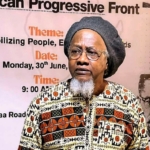
On the sunny day of January 6th, 2026, an intriguing interview was conducted at the Pan-African Progressive Front (PPF) headquarters with Professor Kimani Nehusi by the Directorate of Public Affairs, in collaboration with PPF’s blogger and the Reparations Research Team, led by Sumaila Mohammed. Prof, was formally presented with the Ambassador of Pan-Africanism Medal and presented with the Accra declaration and Special Accra declaration on Reparations adopted at the International Conference of Pan-African Progressive Forces held in Accra in November last year, marking a moment of recognition deeply aligned with the spirit and purpose of the engagement.
Deriving from decades of historical scholarship, Prof. Nehusi emphasised that the enslavement of the African people across the Trans-Atlantic Ocean and colonialism were not isolated crimes of the past, but structured economic projects that extracted labour, land, culture, and sovereignty from Africa and its people. These systems, he noted, continue to shape global inequality today. “Now let’s be clear. Europeans did not come to Africa to either civilize us or Christianize Africans. African people, invented civilisations in Africa independently of any other race or culture.”
In most cases, when the argument for Reparations is raised, its essence and context is backlashed by the notion of “No history, so why demand?” This conversation was raised and discussed during the interview. In response, Prof Kimani began, “The Europeans had to demonize African in order to oppress us, loot and rob the wealth of the continent. So, I say, the reason for the notion of “No history” is, in fact, in service with the oppression of the African people.” He argued.
A particularly important aspect of the discussion that deserves emphasis is the role of the African Diaspora in the struggle for Reparations, not as passive observers, but as active political actors and stakeholders in the process. The forced enslavement and colonisation of African peoples produced one of history’s most enduring injustices: the mass displacement of Africans and people of African descent, many of whom were violently severed from their homelands, identities, and historical continuity.
Today, generations of these displaced Africans continue to seek reconnection with their origins, both materially and spiritually. This reality places the Diaspora at the centre of the reparations discourse; legally, historically, psychologically, and culturally. Their claims are rooted not only in memory and identity, but in documented histories of dispossession and exclusion. As such, the involvement of the African Diaspora is not symbolic; it is foundational to the legitimacy, scope, and success of the reparations struggle.
“Today, in the belly of European beasts, are Africans who suffer from all kinds of diseases. Most of these Africans were kidnapped, snatched away and shipped across the Atlantic”, Prof Kimani noted. He further noted that within the African Diaspora today, there exists a significant number of African people living with diabetes and other chronic health conditions, many of which he argued are the result of long-term, deliberate exposure to harmful systems and environments. He emphasised that many in the Diaspora endure deep psychological and physical trauma simply to survive in Western societies, confronting structural violence and daily hardship while holding on to the hope of one day returning home.
Prof. Nehusi stressed that diasporan communities hold strategic influence in international institutions, academia, legal advocacy, and global media spaces. However, this influence must be intentionally aligned with continental movements to be effective. He therefore spoke at length on the importance of African and Diasporan Unity, emphasising the need to join hands firmly in this fight and redeeming our minds from the colonial shackles which makes us seem different from one another. “Because in essence, we are one.” He ended.
It is within this alignment that the Pan-African Progressive Front (PPF) becomes critical. According to Prof. Nehusi, PPF’s work in convening Pan-African forces, producing research, and centering reparations as a political project positions it as a necessary bridge between African struggles and diasporan activism. Reparations, he insisted, require organisation, data, ideology, and mass political education, which are areas where PPF is increasingly asserting leadership.
He urged, “What PPF can do is organise.” In the wise words of Osagyefo Dr. Kwame Nkrumah, “Organization is everything”. Because to organise the people is to organise ideas, and to organise collective action. He stressed that it is only through sustained political education, disciplined mobilisation, and unity across Africa and the Diaspora that the struggle for Reparations can move from appeal to concrete justice.
“To embark on Reparations is not only to force our oppressors to pay back what they owe us. It is also to socialise and make our own people aware of what’s happened.” In this sense, he explained, the struggle for Reparations is fundamentally transformative. It requires Africans and people of African descent to reclaim their historical consciousness, to unlearn imposed narratives, and to restore a clear vision of themselves and the world. “We must take back our eyes,” he insisted, meaning the ability to see our history with honesty, to recognise our collective strength, and to reimagine our future on our own terms. Reparations, therefore, is not only about material justice, but about restoring dignity, self-knowledge, and the power to define our own reality.
Ultimately, the interview underscored one truth: reparations will not be gifted; they must be demanded through unity, clarity, and structure. As Prof. Nehusi concluded, Africa and its diaspora stand at a decisive historical moment; one that demands coordinated action, not symbolic gestures.
About the Author