
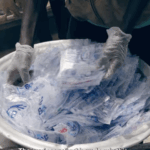
An unusual sight of a long queue, comprising mainly women and children, forms underneath a pavilion in the middle of the Elmina community, a suburb of Ghana’s Central region.
Typically, such winding queues are held either during national or communal activities. But today’s is different. Tightly gripped in the hands of these queuers are bags and bins containing various kinds of plastics they collected, the new currency aside from the cedi.
With their gaze fixed on the ultimate goal, they move quietly and gaily towards the table hosting their hot afternoon meal. Just like a barter trade, the community folks exchange plastics for a satisfying and nutritious meal.
Elmina — a community rich in Ghana’s colonial history. An ancient coastal town where now the tide brings more than the gushing waves: it brings plastics. Here, fishmongers pray for a good catch, but with it now comes a mix of plastics.
The troubling spectacle of the heaps of waste buried along Ghana’s coastlines and in city centres has birthed a zest of both local and global collaborators to end this environmental canker.
This is the journey into ‘Buy Food with Plastic’ – a project born from a question: “What if plastic could feed people, not pollute them?”
This is an initiative that transforms plastic waste into a force for community, sustainability, and hope.
“I brought my plastic waste today, because they breed mosquitoes and consistently make my house filthy. When I brought them, I got food to give to my kids at home,” – a female resident shared happily after she was served.
Across Ghana, the vision takes shape, a simple yet powerful model where plastic becomes currency and food becomes dignity.
Buy Food with Plastic Ghana, founded in 2020 on the initiative of the local country manager, George Kwame Quansah, recognises the potential of the concept to make a sustainable contribution to development for the people in the region.
“The joy that I see in our beneficiaries and how they’ve accepted the project excites me the most as a manager,” Mr Quansah noted.
He and his team are targeting to recycle 110 million plastic bottles and sachets of drinking water over the next five years of the project’s implementation.
They aim to convert these wastes into eco-friendly desks, reducing the over 2 million desks deficits in schools across the country.
The project has, since its inception, not only impacted the Elmina community, but also Dwabor – a cocoa and rubber cultivation community located a few kilometres away from Elmina.
A plastic collection centre has been set up in Elmina, and the first-ever upcycling production facility in the Central region is shaping up. Once completed, it will produce a wide range of products that close the local plastic cycle and offer a sustainable solution to the plastic pollution in the area.
The company is also involved in the local community through radio programmes and school workshops to promote the responsible use of plastic.
The ongoing activities on site create secure local jobs and raise awareness of the plastic problem.
“We believe social entrepreneurship has to be fair and social for everybody. It has to be sustainable for the environment and financially sustainable. Once we achieve this project, we will start to just replicate that model all over the world,” Khalil Radi, Co-founder and Co-CEO at Buy Food With Plastics.
From plastic to purpose, from meals to meaning, Buy Food with Plastic is a reminder that even the smallest act can shift the tide.
This is just not their story, but it’s ours – a reminder that innovation can emerge from compassion. Because when plastics feed people, hope becomes tangible, and every act of care brings a community closer to the imagined greener and safer world.
Joseph Amino captures this eco-friendly story in his docu-interview via:
About the Author
