The young, energetic, Chief Executive of Ghana’s Driver and Vehicle Licensing Authority (DVLA), Julius Neequaye Kotey, has gone to lengths on TV to educate the public about the layout and security features of the new vehicle licence plates the DVLA plans to introduce in 2026.
The new licence plates will have the following on it:
- The region in which the vehicle is registered will be inscribed at the top of the vehicle registration plate’. eg. Greater-Accra.
- ii. At the bottom of the plate, the slogan of the region will be written.
- iii. In the middle of the plate will be the vehicle number, which ranges from 1 to 9999 followed by two letters which represent the region in which the vehicle was registered, eg GR for Greater Accra, CR for Central Region.
Next to the two letters representing the region is a two letter code representing the DVLA office at which the vehicle was registered. So a typical plate would look like this: 3648-GRXY or 5285-CRTD. iv. Finally, the map of the region in which the registration plate is issued will feature in the background.
More importantly, the new number plates will be manufactured and issued by the DVLA and will not be outsourced to private companies. They will have advanced security features embedded in them to ensure that vehicles can be promptly scanned and traced by the security agencies.
Mr. Kotey says these security features will make the process of determining whether vehicles are properly licenced, stolen, customs duties paid on them or whether vehicles been involved in crime etc. more efficient. These are great improvements over the number plates currently in use.
Mr. Kotey has unshaken belief in the new tech laden number plates’ ability to help the security agencies obtain instant information on, scan and track vehicles and their owners in real time and greatly assist the fight against crimes committed with cars, trace road traffic offenders, customs duty evaders etc. These, plus the fact that the plates will be manufactured by DVLA and entered into DVLA’s database makes for a bombproof regime per Mr. Kotey. Bravo…
I think the security of our number plates and their role in helping to apprehend crime depends much more than in house issuance of these plates and the security features installed in them.
My first quarrel with the number plate is its visual appearance. I think it has too much unrequired information. The regional identification, regional slogan and regional map which will feature on the number plate are details that do not immediately aid in identifying a vehicle involved in hit and run incidents, or vehicles involved in crime. Most of our roads are unlit and will remain so for the next twenty years.
If one runs over an old lady on Adjiriganno’s poorly lit roads at night, no scanner or camera will detect his vehicle if he uses the back roads all the way to Abokobi. The next day he can go to a workshop, say he struck a goat and have it repaired. No questions asked. Case closed. That is the reality.
Inscribing the region of registration on the top of the number plate of a vehicle, will not help the police or DVLA trace a vehicle. The license plate number will. In Ghana we do not teach number plate spotting. Let’s reduce the amount of detail people can memorize. The regional slogans are a nice touch, but they are just a gimmick. If we delete these two items and the regional map, we’ll have less clutter on the number plate.
My second issue is with the numbering layout of the number plate. Gone are the two alphabets we are used to which start the numbering. Instead we have a number eg 1317 or 4790 and then the region, GR or BA and then a code representing the point of registration of the vehicle, such as XY or CJ. What use is the point of registration of a vehicle, such as Adenta or Winneba on a number plate? That information should be available to law enforcement at the click of a button. To remove the year of registration as DVLA seeks to do and replace it with the point of registration is to recreate the problem.
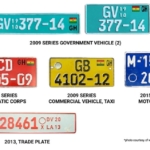
The addition of the year of registration to our vehicle number plate information begun in 2009. Prior to that, in or about 1991, we were compelled to re-register our vehicles. The 1991 re-registration exercise involved the addition of an alphabet after the numeric identification. Before 1991 a car was registered as GM 3648 or GX 4790. In 1991 a car was re-registered as GR-1050-A or GN-333-A. When the sequence of alphabets ended with Z in 2008, DVLA replaced the alphabet at the end of the registration number with the year of registration. For 2009, a vehicle was registered as GR 6070-09 or GR-7256-09. Both these “re- registration exercises” have not made our vehicle license plates more secure or easier to identify.
Mr. Kotey’s faith in the impregnability of the number plates to be introduced next year notwithstanding, the deployment of scanners, cameras, devices: technology; and the efficiency of our security services and his outfit, I daresay, very many, if not most, hit and run vehicles and other crimes involving cars are identified and tracked ‘manually’ with the help of the public. The public helps the police by giving them information on number plates.
A number plate with too much information will confuse even the most diligent and observant passerby. It is simply a bit much to read quickly and memorize. Ghanaians are generally inattentive and unobservant regarding vehicle number plates. Many vehicle owners do not know their licence plate numbers. At functions, vehicle numbers are announced by MC’s for long periods without their owners reacting. As kids, memorizing and reeling off our neigbours vehicle numbers were part of our games. They were simple and easy to learn. Compare memorizing the AZ 3299 of 50 years ago to AZ-3299-C or AZ-3299-21 or 3299- AZTF. Which can you remember easily?
There are so many vehicles on our roads now. Our traffic lights don’t work and our street lights hardly work. Most of our streets are dark at night and we will not have sufficient numbers of cameras and scanners where they are required. We cannot deploy enough technology to help track and trace vehicles. Our back roads will be back roads, dark and easy to flee from without detection.
My humble submission is this; we should revert to the old (pre 1991) format of two alphabets followed by up to four numbers. The twenty-six letter English alphabet, which even barely literate and inattentive persons can easily read and remember, can be combined in so many two alphabet variants and still be identifiable by region.
Two letter combinations of the alphabet are almost inexhaustible. They, especially when placed at the beginning of a number plate give it its identity. GM 3648 or GX 1317 is easier to capture and memorise than 3648-GMXY or 1317-GRXY. A schoolkid is more likely to see and memorize ER 4415 as it whizzes past him, as is a bored, sleepy policeman on a dark road in Agona Nyakrom, than 4415 ERKS with other information clamouring for attention. Lets’ keep the actual numbering simple and leave region of registration, and point/centre of registration, together with other information on vehicles such as chassis numbers and year of manufacture on the DVLA’S database. Simple registration numbers and uncluttered licence plates will be far more helpful in helping identify, trace and track vehicles, compared to what DVLA plans for us.
Finally, the DVLA must only produce licence plates with clearly visible font sizes and styles, as per the regulations. The tiny, illegible font sizes on licence plates that go past police barriers unhindered should be banished in 2026.
My humble thoughts…
Johnny Blukoo-Allotey, Accra.
About the Author