
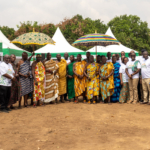
The Kwame Nkrumah University of Science and Technology (KNUST) has officially launched the Nkabom Collaborative Project, a flagship initiative aimed at transforming Ghana’s agri-food and nutrition ecosystem.
Speaking at the launch on Farmers’ Day, Mr Piere Brunache Jr., Director of the Nkabom Collaborative Secretariat at McGill University, Canada, described the project as a platform that will create thousands of jobs and support the development of small- and medium-sized enterprises.
“This Centre will serve as a training ground for thousands of Ghanaians. The Nkabom Collaborative aims to create 55,000 jobs and establish 3,000 small- to medium-sized enterprises,” Brunache said.
“The youth will learn that agriculture is not just about production. With tools like drones and other innovations, students and entrepreneurs will engage in experiential learning beyond the traditional classroom.”
As part of the launch, KNUST also inaugurated the Agri-Food Centre of Excellence in partnership with the College of Agriculture and Natural Resources (CANR). Project Lead, Prof. William Otoo Ellis, said the initiative is intended to build capacities across agri-food value chains, empowering young Ghanaians to innovate and excel in agriculture.
“We hope that within the next 10 years of implementing this project, lives will be transformed. It is not only about individual livelihoods; the impact extends to communities,” Prof. Ellis said, emphasising the significance of launching the project on Farmers’ Day.
Vice-Chancellor of KNUST, Prof. Rita Akosua Dickson, reaffirmed the university’s commitment to driving national development through science, technology, and human capacity building.
“The initiatives we are launching today respond directly to the urgent and emerging needs within Ghana’s agri-food and nutrition sectors. As a university, we pledge our utmost support,” she said.
The Nkabom Collaborative Project brings together seven academic institutions, government agencies, industry partners, NGOs, and local communities to harmonise education, research, innovation, entrepreneurship, and workforce development.
The launch featured an exhibition showcasing innovative works by various departments within CANR, highlighting the potential for research to drive real-world solutions in agriculture.
About the Author