
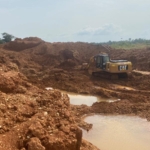
In the early hours of December 4, 2025, a NAIMOS task force set out from Accra for its usual galamsey fight. Their departure at 0330 hours marked the beginning of a determined push into the Eastern Region, where illegal mining activities had taken deep root. By 0730 hours the team had reached the Fanteakwa South District and immediately began a daylong operation that stretched late into the evening.
Their first point of action was the Bunso enclave, specifically Sector E, where the scars of uncontrolled mining were visible long before the team arrived at the active sites. At one of the locations, the officers found two heavy Lonking excavators, a payloader, two pumping machines, fuel, and a motorbike, all of which had been left behind in the rush to escape.
The machines were seized and loaded onto three low-bed trucks for transport to Accra. The hurried flight of the operators summed up the atmosphere that surrounded the operation. The mere presence of NAIMOS was enough to send illegal miners scattering into the surrounding terrain.

The task force then moved toward Nsutem, where another site, said locally to be linked to a businessman in the area, contained additional earth-moving equipment. To prevent further use of the excavators found there, officers removed the control panels and monitors. Two more pumping machines were taken into custody as part of the operation. Across both sites, the miners reacted in the same manner; the moment NAIMOS vehicles appeared, they abandoned their stations and disappeared into the bush, leaving machines, tools, and makeshift shelters behind.
Earlier in the dawn hours, at Nkronso near Apedwa, the team encountered an incident unrelated to confrontation with miners. A stone, believed to have been ejected from the tyre of a passing vehicle, struck the windscreen of a NAIMOS pickup truck, shattering the glass. Although the team continued its mission, the damaged vehicle later had to be returned to Accra for repairs.

The malfunction of another vehicle, with faulty headlights, forced it to be withdrawn and sent back with the convoy transporting seized equipment. These incidents underscored the uncomfortable reality that the operatives often push forward despite mechanical setbacks, making the achievements of such operations even more significant.
As the day progressed, it became clear that the growing presence of NAIMOS had already altered the landscape of illegal mining activity in the district. Multiple sites had been deserted even before the task force reached them.
In several others, excavator owners had removed control boards or relocated their machines far from the pits in an attempt to disguise their activities or avoid confiscation. The team found vast tracts of farmland that had been stripped bare, carved into deep pits filled with murky water used for gold washing. Residents living near these sites expressed fear for their children, who play close to the exposed pits, and appealed for the land to be reclaimed before lives are lost.

Throughout the mission, NAIMOS officers observed unmistakable signs that their presence had disrupted illegal networks that normally operate without hesitation. Community members who interacted with the team voiced their relief and gratitude. Many described the task force as the first tangible line of defence against the destruction of their environment, praising them for confronting an activity that had robbed their rivers of clarity and their farmlands of fertility.
Despite the operational challenges, damaged vehicles, strenuous terrain, and long hours, the officers maintained a firm commitment to the mission. Their determination affirmed a larger national effort to restore environmental integrity and protect communities threatened by the spread of unregulated mining.

The Fanteakwa South operation, which marked the first day of an extended deployment, demonstrated once again that NAIMOS remains at the forefront of the fight against illegal mining. Their continued presence is reshaping the calculations of galamsey operators, discouraging entrenched networks and proving that swift, coordinated, and persistent enforcement can reverse the damage done across affected regions.
About the Author