
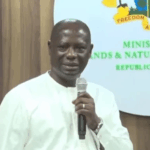
The Minister for Lands and Natural Resources, Mr Emmanuel Armah-Kofi Buah, said 1,033 excavators and other heavy equipment are now being monitored in real time following the rollout of a national tracking and permitting system.
He also announced the introduction of a new medium-scale mining licence category, which he said is aimed at restructuring the sector and encouraging operators to work within the law.
Mr Buah disclosed this during an official working visit by Vice President Prof. Naana Jane Opoku-Agyemang to the Ministry of Lands and Natural Resources on Tuesday, January 27, 2026.
He said weak controls over the importation and use of heavy mining equipment in the past had allowed illegal mining to flourish, particularly in forest reserves and along major river bodies.
“Before we came, it was free for all,” Mr Buah said. He explained that heavy mining machines were imported without registration or monitoring.
“Today, before any heavy equipment is imported, it must be permitted. Once it lands, we track it.”
He said the system allows authorities to impose geographic limits on machinery, restricting where equipment can operate and triggering alerts if they move outside approved locations.
“If you say you are taking an excavator to Obuasi, the tracker will only allow it to go to Obuasi,” Mr Buah said. “If it moves elsewhere, the system flags it.”
Mr Buah disclosed that 1,800 heavy mining machines have been registered over the past six months, marking a sharp departure from earlier periods when such equipment was not captured in national databases.
As part of broader reforms in the mining sector, the minister said the government has introduced a medium-scale mining licence, expanding the existing framework which previously covered only small-scale and large-scale mining.
He explained that the new category is designed to accommodate operators with higher capacity, while ensuring they meet stricter environmental and regulatory standards.
“We are changing the approach,” Mr Buah said.
He added that mining approvals would now originate at the district level through proposed district mining committees, with the involvement of traditional authorities and other local stakeholders.
Mr Buah reaffirmed the government’s position that mining would not be permitted in forest reserves or water bodies, noting that the revocation of mining regulation L.I. 2462 had sent a clear signal about policy direction.
Vice President Opoku-Agyemang welcomed the measures, describing environmental protection as an issue of national survival.
“What you are doing affects life in very direct ways,” she said, and reaffirmed the government’s support for efforts to protect forests, water bodies and communities affected by illegal mining.
The Ministry of Lands and Natural Resources said the tracking of heavy equipment, changes to licensing and decentralised oversight are expected to improve enforcement, strengthen accountability and significantly reduce environmental damage caused by illegal mining.
About the Author
